





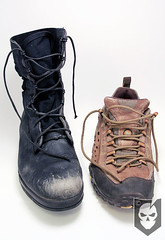
Tired of breaking bootlaces? Replacing bootlaces with 550 cord is something many military personnel are taught as a remedy for broken bootlaces.
It’s also very practical from a survival standpoint. 550 cord, Paracord or Parachute Cord has a multitude of uses in survival or escape and evasion scenarios due to the seven inner strands contained in Mil Spec 550 cord.
Suggestions
We recommend if you’ll be around water that you gut, or remove the inner strands of the 550 to avoid the laces swelling and increasing the difficulty of removing your boots.
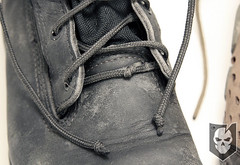
Some other tips on bootlaces are to match the ends up and place a simple overhand knot in the middle of the lace, which will act as a stopping point for the lace when threading it through.
Also the eyelets where your ankle bends can be skip laced to relieve pressure on your Achilles Tendon. See the attached YouTube video for a demonstration of skip lacing.
Finish the laces off with an overhand knot in each of the working ends, wrap the leftovers around your ankle, tie with a square knot (so the don’t get sucked off in the mud) and tuck the excess lace in the top of the boots.
We’ve got an upcoming post where we’ll show why you might just want to keep 550 in your shoelaces too… stay tuned!




{ 10 comments… read them below or add one }
Have you had trouble with the knot coming undone all the time? I seem to have this problem with using 550 cord as a shoe lace.
Nance, are you referring to using gutted or regular 550? On boots the square knot is good to go and doesn’t come out, especially if the laces are tucked into the boot. On shoes with non-gutted 550 try double bow (shoelace) knots.
gutted with a shoelace knot. Hm…
Ever seen people use cordlocs? I don’t know that I’d really want to rely on that in place of a good knot in the field but it’s pretty nice if you’re REALLY lazy, haha. You can use the cordloc out of your PT shorts (usually don’t need it anyway?) and bam, just pull those laces tight and go.
Never used cordlocs on laces, but I’d assume they would slip just like they do on nylon rope. Thanks for the comment!
If the knot is slipping, a double bow will work, but a better knot is made by making a double wrap before pulling the loop through. Here’s a link to what I mean:
http://www.fieggen.com/shoelace/betterbowknot.htm
Just wondering if anyone knows if there is a distinct difference in heat dissapation between gutted and not… With the new flex cuffs the military has, it is only a matter of time before civies get their hands on them. From what I understand, the newer ones are much thicker and contain metal strands inside. Rumor has it, both laces are necessary for removal… Any thoughts?
Great for an emergency. I’ve found that for long term use, the p cord ends up eating the brass eyelets and ends up cutting the p cord laces. It’s probably all the grit along with the nylon. You can usually spin the eyelets with a flathead screwdriver to get some more life out of them until you get them rebuilt (in wildland fire boots at least).
Haven’t seen this mentioned, but we learned in the OnPoint Tactical urban E&E class that I was in. A really great alternative to using 550 cord as bootlaces is duck decoy line. Its solid- you don’t have to gut it, its treated to withstand weather and wetness better and it cuts through zipties, flexcuffs, and phone cord like butter. Also, (this is my favorite part) if you hold about 3/4 inch of each end over a flame, keeping it rotated, the ends will harden lengthwise making perfect lace tips. My men and myself use it in our boots and shoes as well.
Any ideas about paracord for an emergency “rope”? Like you’re on the fourth floor of a building that you can’t get down the normal way, and you absolutely HAVE to get down, for whatever reason (fire, enemy assault, terrorists, what have you). between the 550 in your laces, your wristband, say you have some running along your belt and/or vest… I guess what I’m asking is, is something that’s rated for two or three times your weight something you would trust for a one-time, oh- $h!t scenario? Or is there something about ropes and/or climbing I don’t know about that means it would break before a safe jump-off point and I’d end up as a pancake? The only thing I can think of was in an engineering class that I took for a short time. In the problem we were working, for a structure to be “safe” you figure out the maximum load it will be exposed to and quadruple it. Needless to say, it doesn’t meet those requirements, but then again the problem was building a bunk bed that hung from a ceiling, not a rope for escaping gun toting zealots…
oops just found my answer online… apparently the “working weight,” as the posters put it, “is 60-70 lbs, and the knot is probably half that. So if your doomed, take a chance. Otherwise, don’t try it.” This always happens, I find something out on my own as soon as I ask for help…