




Are Mini Red Dot Sights a Viable Option for Pistols? Jeff Gonzales Joins us for a Q&A
I’m excited to announce a new partnership here on ITS Tactical, with Jeff Gonzales of Trident Concepts as a contributor.... View Article
View ArticleToday we’ll wrap up the last part in our Knot of the Week mini-series on rigging a tarp shelter.
I left off in part 2 with explaining how the tarp is attached to the trunk line with Prusik Loops and Prusik Knots, and introduced the guy-line system. We’ll get more in-depth into that system as well as demonstrating the Alpine Butterfly Loop and the Taut-Line Hitch.
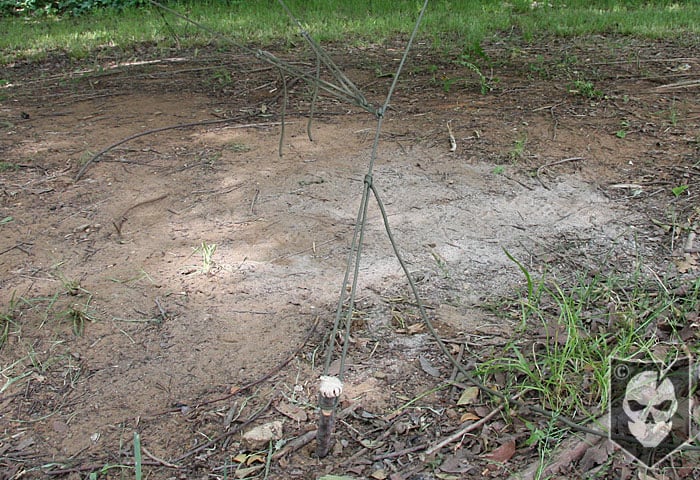
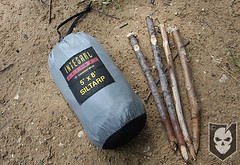
To create the guy-line system you’ll need at least five attachment points on each side of the tarp and quite a bit of paracord. As mentioned previously you’ll also need four stakes, but those can be made with a knife and some sticks you can typically find wherever you’re setting up at.
Before we get into how to tie these knots for the guy-line system, let’s talk paracord. I like using paracord for everything on this tarp, because I know I’ve always got 100+ feet of it at all times.
For each primary guy-line, that will be hitched around one of the four stakes, you’ll need 8-feet of paracord. The secondary guy-lines, on the next closest attachment points, will each require 5-feet and the tertiary lines need 6.5-feet.
In the video below, I’ve tied in each of the guy-lines to their respective attachment points using two half-hitches. Lately though I’ve been considering retying them with bowlines or something similar. The two half-hitches hold just fine, but taking the tarp in and out of the stuff sack I’ve noticed that I occasionally have to re-tighten them.
Cutting all the necessary paracord for the entire tarp shelter will take some time, but once its in place you can set-up and tear-down the tarp in a matter of minutes. Practice makes perfect though, so throw the tarp up in your backyard on occasion to practice setting it up.
(Strength: 5/Secure: 5/Stability: 3/Difficulty: 4)
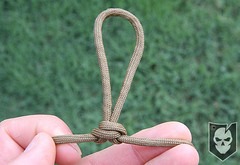
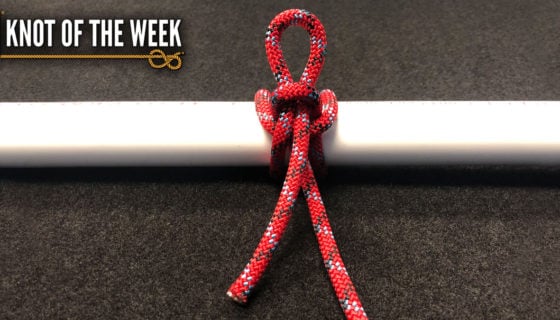
The first step after tying in all of the guy-lines, is to tie your Alpine Butterfly Loop in each of the primary guy-lines. The Alpine Butterfly acts as a anchor for the pulley system that is created by the secondary and tertiary guy-lines on each corner of the tarp. That pulley system is what evenly distributes the tension on each of the respective attachment points to stabilize the tarp in windy conditions.
An Alpine Butterfly is used to put a loop in a line that has tension coming from both ends. This knot will not weaken the strength of the line and is used by climbers and mountaineers to tie in a climber for protection against a fall.
Tying Instructions: Please refer to the photos here and YouTube video below.
(Strength: 3/Secure: 3/Stability: 3/Difficulty: 3)
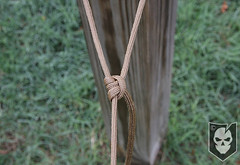
After each primary guy line has the Alpine Butterfly integrated, it’s time to stake them down. The best way to tie off these guy-lines to that stake in the ground is with a Taut-Line Hitch, this will allow you to adjust the tension on the line if needed. While this is the optimal knot to use in this situation, be aware that under heavy loads the hitch can release.
Not only will the primary guy-line have a Taut-Line Hitch, but each secondary and tertiary guy-line will also use one after being routed through the Alpine Butterfly Loop. This will again allow you to individually adjust the tension on these guy-lines to mitigate the amount of flex the tarp has in windy conditions.
Tying Instructions: Please refer to the photos here and YouTube video below.
I hope you’ve enjoyed the series and not only learning how to tie all these great knots, but also seeing how they all come together into a practical application.
Knot tying truly is a depreciable skill-set, and one that I hope everyone takes an interest in and passes along to friends, family and co-workers. With today’s generation of people that are completely dependent on all the fancy gadgets and electronics (guilty), developing skill-sets like these and retaining them is even more important.
Let me know if you have any questions about any of the knots used in this mini-series, and I hope you’ve enjoyed it. Now get a tarp and practice!
Oh, and before anyone asks, I don’t know why I said “happy tarping” at the end of the video, I know it’s absurd and I couldn’t edit it out!
Links to Part 1 and Part 2 of the series in case you missed them!
Please consider joining our Crew Leader Membership and our growing community of supporters.
At ITS Tactical we’re working hard every day to provide different methods, ideas and knowledge that could one day save your life. Instead of simply asking for your support with donations, we’ve developed a membership to allow our readers to support what we do and allow us to give you back something in return.
For less than 14¢ a day you can help contribute directly to our content, and join our growing community of supporters who have directly influenced what we’ve been able to accomplish and where we’re headed.
I’m excited to announce a new partnership here on ITS Tactical, with Jeff Gonzales of Trident Concepts as a contributor.... View Article
View Article
Rigging to rappel is an often undervalued skill. It is certainly a necessary part of rappelling, but most people I... View Article
View Article
Go ahead and poke around, kick the tires, see what’s different. We’re very proud of the newly redesigned ITS and... View Article
View Article
We’ve got a pretty big announcement to share with you today and one that’s been hard to keep quiet about.... View Article
View Article
Peephole security is a real thing, especially when it comes to situations out of your control, like hotel rooms. It’s... View Article
View Article
Odds are you’ve seen a lot of Velcro hook and loop on a variety of things from garments, bags, hats,... View Article
View Article
I recently had the unique opportunity to visit Cooper, TX and interview Mike Ritland, a former Navy SEAL and founder... View Article
View Article
2 of 2 in the series U.S. SpiesU.S. SpiesU.S. Spies: Understanding the World’s Second Oldest ProfessionU.S. Spies: The Intelligence Cycle... View Article
View ArticleI'm excited to announce a new partnership here on ITS Tactical, with Jeff Gonzales of Trident Concepts as a contributor. I co...
In light of recent events, I'd like to go over my suggestions for the medical response to an improvised explosive device expl...
Rigging to rappel is an often undervalued skill. It is certainly a necessary part of rappelling, but most people I know rig q...
Go ahead and poke around, kick the tires, see what's different. We're very proud of the newly redesigned ITS and have worked ...
I am a sovereign man, responsible for my own actions and their consequences. I am the supreme authority of my life, and I may...
4/2/13 Update: As most of you have figured out, this was an April Fools goof that we thought you'd enjoy. It also looks like ...
First off, this isn't a post about what the cause of the explosions were yesterday that rocked Boston, or a "here's what shou...
We've got a pretty big announcement to share with you today and one that's been hard to keep quiet about. For the past few mo...
Ask any accomplished runner, hiker, backpacker, or outdoorsman how they prevent blisters and you'll more than likely get diff...
Peephole security is a real thing, especially when it comes to situations out of your control, like hotel rooms. It's often n...
Odds are you've seen a lot of Velcro hook and loop on a variety of things from garments, bags, hats, morale patches and even ...
See below for winner announcement. While Bryan and Kelly are out having a blast at the Overland Expo, the rest of us back...
Editor-in-Chief's Note: Please join us in welcoming back former Navy SEAL and current Director of Training at Center Mass Gr...
Image via http://infothread.org - Click Image to Enlarge to View Sources
Disclaimer: All names have been changed as to protect the identity of those involved. Sounds. There are many each of us ha...
I recently had the unique opportunity to visit Cooper, TX and interview Mike Ritland, a former Navy SEAL and founder of the W...
When I first considered entering the intelligence community (“IC”), the notion of classic Cold War-style cloak and dagger esp...
In our How To Escape and Evade in an Urban Environment article, we briefly discussed escaping from zip ties. There are qui...
Sugru is an interesting product that I've known about for a few years now, but it wasn't until recently that I picked some up...
Editor-in-Chief's note: This post was written by Brett and Kate McKay and originally ran on The Art of Manliness. The ide...
We're proud to support our good friend and ITS Plank Owner, Karl, from OscarDelta by carrying their Go-Tubes in the ITS Store...
Lock Bumping is quickly becoming a popular way of bypassing a lock without the need for picking. The method uses a key blank ...
One of the things that's sometimes hard to understand in Lock Picking is which pick to use. Many picks look similar and can...
Close your eyes for a minute and join me on a little adventure... You're walking down the sidewalk and pass two shady figures...
If you've read our review of OnPoint Tactical's Urban Escape & Evasion Class and wanted to attend, now is your chance. ...
We've often talked about certain aspects of disappearing here at ITS, such as an untraceable cell phone and how to escape and...
I'll admit I'm a bit of an organizational freak, but my wife and those that know me would probably say that's an understateme...
I'm often asked what I do and I feel obligated to respond, “I could tell you, but then I'd have to kill you.” When people men...
Today we'll be looking at the 2nd part of our Inside Red Team Operations series, which takes us through the process of planni...
It's with disappointment that I write this post today, but with a strong stance on what ITS Tactical will tolerate from who w...
We wound up with some extra Carry The Load Morale Patches that we had made up for this year's event and we're giving you one ...
We just completed adding some awesomeness to the ITS Tactical Store a few minutes ago and are super excited to be offering ou...
There's just five more days to get your video response in on YouTube to win one of the three tremendous prize packages from R...
We'd like for all our readers to check out the new additions we've made to the ITS Forum, especially the newly created sponso...
There's a couple of things you should be doing today if you haven't already... Sending in your YouTube Video Response for ...
Today in part four of our DIY AR-15 Build you'll learn how to install the Pivot Pin on your Lower Receiver and hopefully take...
We'd like to announce a special Crew Leader Membership sale good for only the first 15 people to sign up! Our yearly Crew ...
Today marks the start of a new series on ITS Tactical where we'll be walking you through the COMPLETE assembly of a Direct Ga...
Today in part five of our DIY AR-15 Build you'll learn how to install the Trigger Group in your Lower Receiver. The trigge...
We have some very exciting news to share with you guys today! To mark our recent milestone of 2,500 YouTube subscribers, we'v...
Continuing our DIY AR-15 Build, today we'll be installing our Bravo Company 14.5" Barrel and Daniel Defense 9" Lite Rail onto...
If you haven't yet seen our newest advertiser, let us take a second and introduce you to Pimps n' Mercs before we get into th...
Welcome back to our DIY AR-15 Build and the start of our tutorials on assembling your Upper Receiver and finishing the build!...
One of my personal goals for 2012 was to learn tubular lock picking and become proficient enough to share my knowledge with e...
Today in part three of our DIY AR-15 Build you'll learn how to install the Bolt Catch on your Lower Receiver. This step is...
An unfortunate turn of events has occurred surrounding the latest issue of RECOIL Magazine. Everyone at ITS HQ was ecstatic w...
Today in part eight of our DIY AR-15 Build we'll be showing you how to install the final part onto your Lower Receiver, the B...
Today we'll be showing how to pick your way out of Handcuffs using only a bobby pin. We realize this may be a sensitive issu...
Today in our fifth installment of the DIY AR-15 Build Upper, we'll be installing the Flash Hider. We won't technically be ins...
Today in part two of our DIY AR-15 Build you'll learn how to install the Magazine Catch on your Lower Receiver. While fair...
I am a sovereign man, responsible for my own actions and their consequences. I am the supreme authority of my... View Article
4/2/13 Update: As most of you have figured out, this was an April Fools goof that we thought you’d enjoy.... View Article
First off, this isn’t a post about what the cause of the explosions were yesterday that rocked Boston, or a... View Article
Ask any accomplished runner, hiker, backpacker, or outdoorsman how they prevent blisters and you’ll more than likely get different answers... View Article
Editor-in-Chief’s Note: Please join us in welcoming back former Navy SEAL and current Director of Training at Center Mass Group,... View Article
In light of recent events, I’d like to go over my suggestions for the medical response to an improvised explosive... View Article
See below for winner announcement. While Bryan and Kelly are out having a blast at the Overland Expo, the rest... View Article
Disclaimer: All names have been changed as to protect the identity of those involved. Sounds. There are many each of... View Article
Editor-in-Chief’s note: This post was written by Brett and Kate McKay and originally ran on The Art of Manliness. The... View Article
The Steepest Race in Europe
[1957] Ryan X-13 Vertijet test flight in Washington DC
11 Comments
There’s actually a much faster way to tie the butterfly loop. It’s much faster and you can do it in the dark.
You take the rope or cord, hold it with the thumb of either hand, feed it over towards your fingers/knuckles, then loop it around back over towards your thumb twice. Then pull the loop on your palm farthest from your thumb out, then back towards your wrist and under all the other loops. Pull it off and dress your new butterfly knot.
That’s how I learned it, it’s a little messier than
http://www.animatedknots.com/alpinebutterfly/index.php?LogoImage=LogoGrog.jpg&Website=www.animatedknots.com
But I find it much easier.
I personally find the method illustrated in this video for tying an alpine butterfly a LOT easier than that alternate method. When I do the two twists, I leave my left thumb in the loop where you feed the main bight through to finish the knot. Cold hands, limited visibility, etc., no problem…
Great video series, thanks…
BM
I find this method to be the easiest for the butterfly: http://www.asiteaboutnothing.net/cr_most-useful-knots.html
When teaching the Alpine Butterfly, I never ever teach the over the hand method. When it’s used for rigs that could have sudden weight put on the rope (for me, roof safety systems and rescue rigs), the around the hand method means you can lose all your fingers very easily. Never ever wrap a rope that may have unexpected force put on it around any part of your body.
Thanks for the interesting article.
Here is an alternate way of tying the Alpine Butterfly Loop knot that I personally use which is easy to do and remember. Possibly easier to do in limited visibility too.
http://www.animatedknots.com/alpinebutterfly/index.php
Dude I was cracking up when you said 'happy tarping'. Not absurd, hilarious.
i was wondering what is the brand of hatchet you used in this video and if you find it secures to a pack easily
James, it’s a Gerber and while I like it’s size and blade strength and ease of resharpening, I dislike the case. I used an old TA-50 clip to secure it to my pack. It does have a loop to put it on your belt, but I’m not a happy “camper” about the case.
thank you
Two points:
1. While I understand that this is ITS Tactical, and that therefore the currently-fashionable coyote brown paracord is de rigeur, tan paracord over a brown forest floor, ah, fulfills all of its low-visibility potential, especially in 480p Youtube videos. This is counterproductive to your instructional purpose. Perhaps next time, something in a blaze orange or other highly visible color?
2. This was interesting and instructional; however, many of us prefer not to carry any more unitaskers than necessary. How would you modify the technique to work with a poncho?
I lied. Three points:
3. While the guy line rigging system is indeed clever and speedy, I would point out that it also has only four points of failure rather than a dozen. In truly volatile conditions, a dozen anchors would be superior.
Absolutely brilliant. I’ve been backpacking and mountaineering for about a decade plus a few years, and I have never seen anyone use this for tarps. Like you, I did the old 6 individual lines, and always deal with the bowing on windy locations. Granted we usually just use the tarp for day shelter in storms, or for cooking while backpacking, rather than a primary shelter.
I’ve also never used the prussik method, though I have seen similar setups. Seeing yours setup though just made sense, gives you the ability to fine tune the location of the tarp between your anchors and keeps water from dripping in. Only downside is it can’t be used with trekking poles, which is why I usually go directly to the tarp.
Thanks for doing this video series, learned a lot from the site about fitness and evasion/survival. but this is definitely going to get many uses per year.