




The relaunched ITS Online Store is live with awesome new products!

email
share

550 Cord Bootlaces

by The ITS Crew on July 14, 2009

email
share

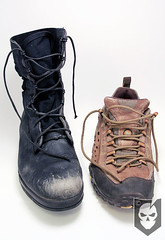
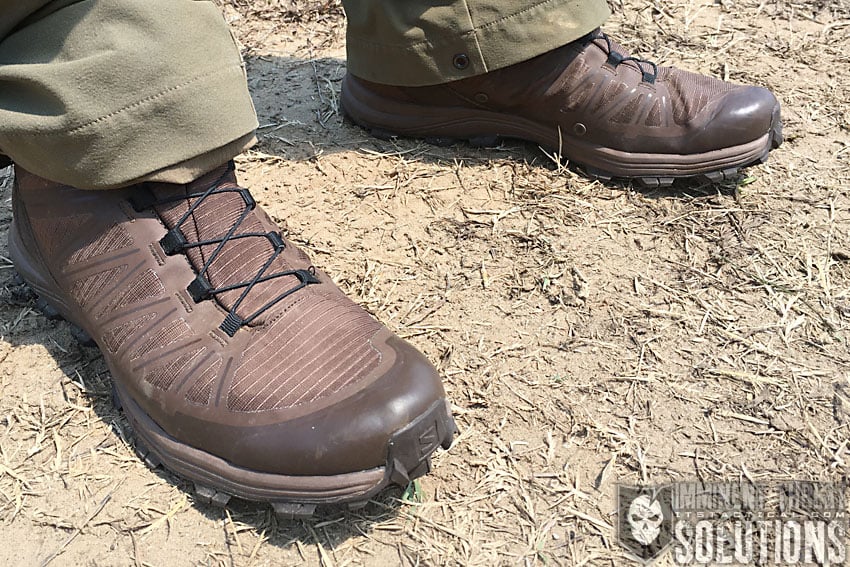
550 Cord Bootlaces 01Tired of breaking bootlaces? Replacing bootlaces with 550 cord is something many military personnel are taught as a remedy for broken bootlaces.

It’s also very practical from a survival standpoint. 550 cord, Paracord or Parachute Cord has a multitude of uses in survival or escape and evasion scenarios due to the seven inner strands contained in Mil Spec 550 cord.

Suggestions

We recommend if you’ll be around water that you gut, or remove the inner strands of the 550 to avoid the laces swelling and increasing the difficulty of removing your boots.
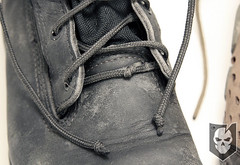
550 Cord Bootlaces 02Some other tips on bootlaces are to match the ends up and place a simple overhand knot in the middle of the lace, which will act as a stopping point for the lace when threading it through.

Also the eyelets where your ankle bends can be skip laced to relieve pressure on your Achilles Tendon. See the attached YouTube video for a demonstration of skip lacing.

Finish the laces off with an overhand knot in each of the working ends, wrap the leftovers around your ankle, tie with a square knot (so the don’t get sucked off in the mud) and tuck the excess lace in the top of the boots.

We’ve got an upcoming post where we’ll show why you might just want to keep 550 in your shoelaces too… stay tuned!
Are you getting more than 14¢ of value per day from ITS Tactical?

Become a Crew Leader!

Please consider joining our Crew Leader Membership and our growing community of supporters.

At ITS Tactical we’re working hard every day to provide different methods, ideas and knowledge that could one day save your life. Instead of simply asking for your support with donations, we’ve developed a membership to allow our readers to support what we do and allow us to give you back something in return.

For less than 14¢ a day you can help contribute directly to our content, and join our growing community of supporters who have directly influenced what we’ve been able to accomplish and where we’re headed.

Click here to learn about all the benefits and Join!

email
share

{ 15 comments… read them below or add oneDiscuss in our Forum }

Have you had trouble with the knot coming undone all the time? I seem to have this problem with using 550 cord as a shoe lace.

Reply

Nance, are you referring to using gutted or regular 550? On boots the square knot is good to go and doesn’t come out, especially if the laces are tucked into the boot. On shoes with non-gutted 550 try double bow (shoelace) knots.

Reply

gutted with a shoelace knot. Hm…

Ever seen people use cordlocs? I don’t know that I’d really want to rely on that in place of a good knot in the field but it’s pretty nice if you’re REALLY lazy, haha. You can use the cordloc out of your PT shorts (usually don’t need it anyway?) and bam, just pull those laces tight and go.

Reply

Never used cordlocs on laces, but I’d assume they would slip just like they do on nylon rope. Thanks for the comment!

volk_odinochka December 4, 2010 at 1:14 am
Thumb up Thumb down 0

Agree totally. Flat laces or laces with no core inside then it’s the regular shoe lace knot. Laces with a core a square knot is great. Not only do they not come undone easily but if they get wet and/or frozen I’m still able to undo them quick even with gloves.

Reply

Franklin Klock October 23, 2009 at 6:34 am
Thumb up Thumb down 0

If the knot is slipping, a double bow will work, but a better knot is made by making a double wrap before pulling the loop through. Here’s a link to what I mean:

http://www.fieggen.com/shoelace/betterbowknot.htm

Reply

Just wondering if anyone knows if there is a distinct difference in heat dissapation between gutted and not… With the new flex cuffs the military has, it is only a matter of time before civies get their hands on them. From what I understand, the newer ones are much thicker and contain metal strands inside. Rumor has it, both laces are necessary for removal… Any thoughts?

Reply

Great for an emergency. I’ve found that for long term use, the p cord ends up eating the brass eyelets and ends up cutting the p cord laces. It’s probably all the grit along with the nylon. You can usually spin the eyelets with a flathead screwdriver to get some more life out of them until you get them rebuilt (in wildland fire boots at least).

Reply

Haven’t seen this mentioned, but we learned in the OnPoint Tactical urban E&E class that I was in. A really great alternative to using 550 cord as bootlaces is duck decoy line. Its solid- you don’t have to gut it, its treated to withstand weather and wetness better and it cuts through zipties, flexcuffs, and phone cord like butter. Also, (this is my favorite part) if you hold about 3/4 inch of each end over a flame, keeping it rotated, the ends will harden lengthwise making perfect lace tips. My men and myself use it in our boots and shoes as well.

Reply

John Taxpayer December 14, 2010 at 5:54 pm
Thumb up Thumb down 0

I’m interested in the decoy line. What type are you using? I have found solid PVC, braided nylon, braided and tarred nylon, braided polyester.

Reply

Any ideas about paracord for an emergency “rope”? Like you’re on the fourth floor of a building that you can’t get down the normal way, and you absolutely HAVE to get down, for whatever reason (fire, enemy assault, terrorists, what have you). between the 550 in your laces, your wristband, say you have some running along your belt and/or vest… I guess what I’m asking is, is something that’s rated for two or three times your weight something you would trust for a one-time, oh- $h!t scenario? Or is there something about ropes and/or climbing I don’t know about that means it would break before a safe jump-off point and I’d end up as a pancake? The only thing I can think of was in an engineering class that I took for a short time. In the problem we were working, for a structure to be “safe” you figure out the maximum load it will be exposed to and quadruple it. Needless to say, it doesn’t meet those requirements, but then again the problem was building a bunk bed that hung from a ceiling, not a rope for escaping gun toting zealots…

Reply

oops just found my answer online… apparently the “working weight,” as the posters put it, “is 60-70 lbs, and the knot is probably half that. So if your doomed, take a chance. Otherwise, don’t try it.” This always happens, I find something out on my own as soon as I ask for help…

Reply

Blake, did it mention why the working weight is drastically lower than the test? It doesn’t make a hell of a lot of sense to me to call it 550 cord for decades when the reality is that it’s going to snap if you load it with 100 lbs. Anyway, not arguing with you, just curious.

Reply

Amsteel Blue is a wicked strong. The 1/4″ is rated at 7,700 lbs.

You definitely pay for it – but I know quite a few ultralight backpackers who swear by it for hammocks and the such.

Reply

Blake-
For the example you give, I suggest you head to an outdoors store (REI comes to mind) and buy 50-100 feet of whats called “prusik” cord. While 50′ of 1/2″ (12mm) kernmantle will fill a 8×16 bag, the same length of 3/8″ can fit into a GI LCII 3-magazine pouch, with room for harness webbing to boot.

(Use 1″ tubular webbing – it’s a lot comfier than using rope like Uncle taught for a swiss seat)

While prusik cord’s tested strength is far below the usual limit for “regular” use (1/2″ typically rates over 9,000 Lbs while 3/8″ is only 1,900) if it’s a choice between burning to death, being shot or making a try for a longer life you’ll at least have your options open.

Reply

« Previous post

Next post »