




Knot of the Week: Hasty Webbing Harness
by March 26, 2010 03/26/10

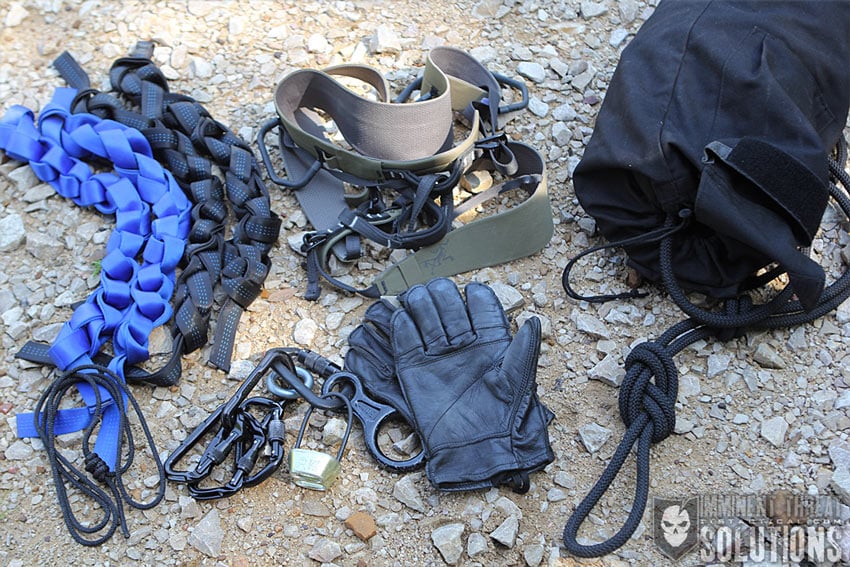
This week’s Knot of the Week features two different ways to tie a hasty webbing harness that can be used as a backup rappelling harness in case of an emergency.

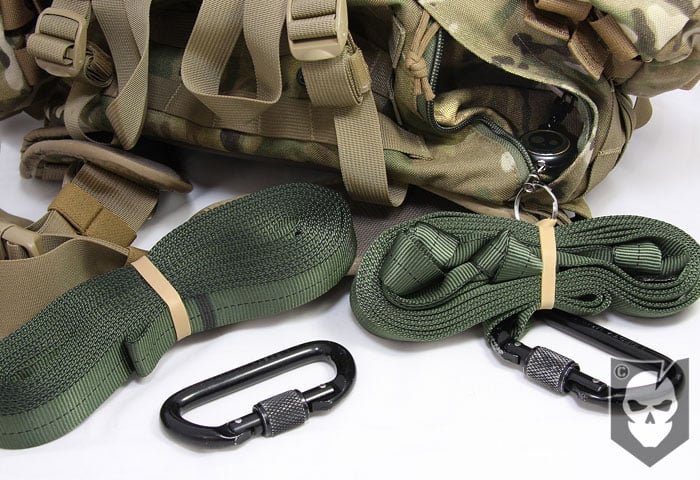
Tied with 1″ Mil-Spec Tubular Webbing, these featured harnesses have a rating of 19 kN or 4,200 lbs. Tubular Webbing is commonly used in climbing and readily available in either Mil-Spec or Climb-Spec. You’ll find that these are very similar and maintain roughly the same 19 kN rating.

If you’re looking to source 1″ Tubular Webbing, here’s a  great resource that aggregates pricing and availability from popular online retailers like REI, Amazon, Summit Hut and many more.

Method #1
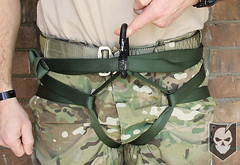
Hasty Webbing Harness 01The first way that we’ll show to tie a Hasty Rappelling Harness is very similar to the Swiss Seat, but as the name implies, hasty. There are ways of reinforcing this harness with tape knots, which we point out in the video below.

This first harness example is tied with 18 ft. of Tubular Webbing and is easily stored in a cargo pocket. One of the main benefits of this harness is that storing the webbing coiled and flat minimizes space and takes up much less room than 18 ft. of rope. Tubular Webbing is also more comfortable to use as a harness, but the purpose of backup harnesses like these is for emergencies, and comfort really shouldn’t be a concern in those situations.

Method #2
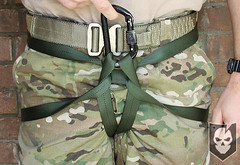
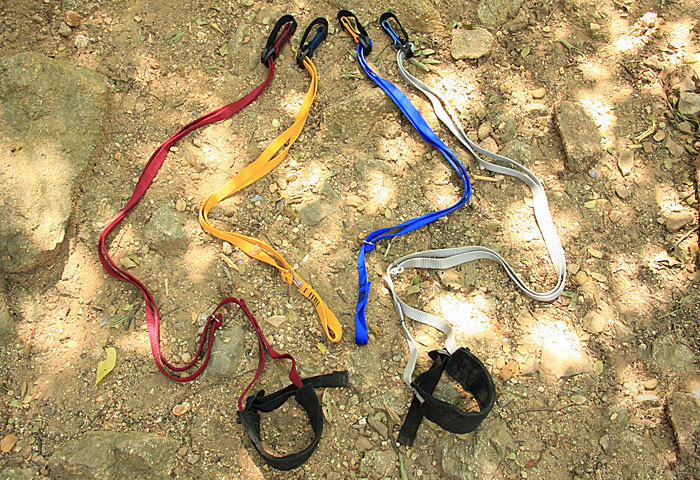
Hasty Webbing Harness 02The second method we’ll show to tie a Hasty Rappelling Harness is something we’ve come up with recently. It utilizes 12 ft. of pre-knotted Tubular Webbing (a Tape Knot that’s been backed up) to make a runner of sorts that can be easily donned in a hurry. This method is much faster than the first example and uses less webbing.

It’s not as secure as the first harness, but if seconds count, it will get you down. It’s also more compact and easier to store than the first, and as you’ll see in the video, it fits very nicely into the flashlight cave of a TAD Gear Fast Pack in conjunction with their Cable Retractor.

What really makes this method shine is its ability to augment a Rigger’s Belt. As you can see from the picture to the right  it would be very easy to clip this into the loop. When used in combination with the Rigger’s belt you’ve truly got a bombproof backup system. No leg support has been a common complaint with a Rigger’s Belt, but when used in combination with this method, it will be sure to satisfy.

Notes

Both of these harnesses utilize Rigger’s Rubber Bands to hold them together for quick deployment when needed. Here’s a link to an article we wrote on Rigger’s Rubber Bands, they’re definitely the right choice for this application.

Always use a locking carabiner when tying these harnesses and remember to “Screw Down, so you don’t Screw Up.” That’s something helpful to memorize so that you’re always screwing the locking gate on a carabiner “down.” If gravity comes into play it will rotate the carabiner closed, not open.

Hasty Webbing Harness #1 » Misc.

(Strength: 2/Secure: 3/Stability: 2/Difficulty: 3)

Hasty Webbing Harness #2 » Misc.

(Strength: 2/Secure: 3/Stability: 2/Difficulty: 2)

Please refer to our  Knot of the Week introduction post for a description of what these ratings mean.

Uses:

  • Hasty emergency rappelling harness for you or a victim
  • Transporting an injured victim to safety

Tying Instructions:

  • Please refer to the YouTube video below for instructions

Rappelling is inherently dangerous. This information is provided for educational purposes only, and should not replace training from an experienced guide.
Are you getting more than 14¢ of value per day from ITS Tactical?

Please consider joining our Crew Leader Membership and our growing community of supporters.

At ITS Tactical we’re working hard every day to provide different methods, ideas and knowledge that could one day save your life. Instead of simply asking for your support with donations, we’ve developed a membership to allow our readers to support what we do and allow us to give you back something in return.

For less than 14¢ a day you can help contribute directly to our content, and join our growing community of supporters who have directly influenced what we’ve been able to accomplish and where we’re headed.

Click here to learn about all the benefits and Join!


23 Comments

  • ReactGear says:

    Great video, you make it look too easy.

  • Cossa24 says:

    Good one!
    When I was young and dumb we would go out to the cliffs in Dahlonega, Ga and repel. Not being able to afford “fancy” gear at the time, I often used tubular webbing to make a “swiss seat.”
    This is good one to know. In a pinch you can make it out of just about anything. So a good twistlock carabiner is good to keep in your BOB.

  • Dustin says:

    Awesome video. Thanks for the demonstration and I’m looking forward to more relating to this topic.

  • Rusty Gray says:

    We used to tie up a seat very similar in the 80′s called a French seat. It was far more comfortable than a swiss seat for extended ops in the rocks.

    I use a similar seat now but use bright yellow high strength webbing.

    Very cool. Love this site.

  • Tango7 says:

    Good tips guys. I’ve kept a prefab loop and 50′ of 3/8″ Nylon kernmantle on my belt at the Fire Department for a few years now in case I get stuck somewhere.

    “As long as it works, it ain’t stupid”

    • ITS Admin says:

      Very true Tango 7. Its about what works, and nearly anything will work in a pinch. It’s good to have the knowledge though to be able to turn that rope into whatever the situation calls for.

      Thanks for the comment,
      Bryan

  • runnningdog8 says:

    Great post and a very well done video!

  • Mike says:

    Would someone point me to the cable retractor mentioned in this post? I’ve looked through the TAD site and can’t seem to find it.

  • Cdt Gillies says:

    You can also use a tubular webbing sling, you put it behind you and feed it around both sides and between your legs, then connect the 3 points withe a carabiner. This is really emergency only, but it’s by far the quickest

    • ITS Admin says:

      Gillies,

      That’s close to what we did here, but the second method shown is superior to that, as it leaves two points of contact for the carabiner, not two. That method we show will also move the leg loops further away from your junk.

      ~ Bryan

  • Daryl says:

    Daisy chain another snaplink in there and you’ll save wear and tear on your tubular nylon and possibly prevent a burn through.

  • TFA303 says:

    Great ideas here.
    The link to the Rigger’s Rubber Bands site doesn’t appear to be working.

  • ZenEngineer says:

    It’s interesting that the still photos show the person wearing a “riggers” belt while also using the improvised swiss seat. Could a shorter piece of 1″ tubular nylon be prepared with leg loops to be used in conjunction with the riggers belt?

  • Waykno says:

    Make your own “rigger's rubber bands.” Buy a bicycle inner tube and cut it to whatever width you like. Granted, they aren't as flexible (stretchy) but they work for their limited application. Much cheaper too.

  • Definitely not as strong, but great tip to add!

    Thanks for the comment,
    Bryan

  • David says:

    New favorite site.

    I’m having a hard time figuring out what you’re doing in the video around the 6:50 mark. How do the “2 loops” that come around your waist attach to the crotch loop before you hook the carabiner to the two loops?

  • David H. says:

    I cut seat belts from totaled cars. (Seat belts not damaged) but I cut the whole lenght of each. Would a seat belt suffice? I know these have to be rated as one of the strongest items out there in order to ensure the safety of drivers. I use them for strap attachments etc. But could you use em for this harness?

  • Justin says:

    My nutz hurt after watching this. Thx for sacrificing yours to make the vid

    • Common Sense says:

      A properly tied harness is just a bit uncomfortable when tightened. You literally have to lift and move your nuts, then tighten the harness. You will have a strange looking bulge in your pants, but that means that nothing is under the webbing itself. Properly tied, this harness won’t cause a lot of pain if used for straight forward rappelling.

  • doooooood says:

    curious if you actually tested your hasty harness set up to 19 kN as stated?

    I would guess not or at least not to standard as my testing revealed much lower numbers for this configuration.

Leave a Reply

Your email address will not be published. Required fields are marked *

You may use these HTML tags and attributes: <a href="" title=""> <abbr title=""> <acronym title=""> <b> <blockquote cite=""> <cite> <code> <del datetime=""> <em> <i> <q cite=""> <strike> <strong>

The Latest
Squawk Box