




n

12 Things You Need In Your Vehicle Emergency Kit
by ITS Admin on December 6, 2009

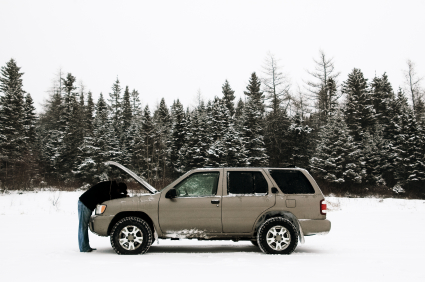
VehicleEmergencyKitWith winter already upon us, it’s time that we all evaluate just what we have in our vehicles, and if it’s enough to handle an emergency situation.

The list we’ve come up with today is what we feel that, at a minimum, you should have with you in your vehicle.

Most of our readers are probably already prepared with these essentials, but it never hurts to share this information with those you care about. I’m sure we all people we know and love that hardly even carry a jack with them.

Instead of getting into a huge article on all the things you could potentially need in an emergency situation, we’ve decided to come up with a simple, basic list that creates the foundation of your Vehicle Emergency Kit.

We’ll definitely be expanding on this list and topic in the future, but it’s time that you at least get this stuff in your vehicle!

Jumper Cables
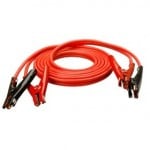
41-MMD1k+vL._SL500_AA280_One of the best things you can carry with you is a good set of Jumper Cables, this isn’t a time to get cheap, and like your grandfather always said “Buy cheap, buy twice.”

There’s plenty of cheap “made in china” cables out there, so be cautious. We recommend getting cables with multiple strand four gauge copper wire.

The alligator clips should also be made of copper with pressed/crimped connections to the cables. One of our readers pointed out that for high currents, soldered connections should be avoided as the solder might melt.

We recommend at least 12 feet of length, and the more the better. 16 feet is ideal for most situations and should allow you to get a jump from someone behind you if need be.

Flashlight
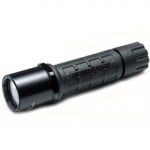
41Ep24w51ML._SL500_AA280_Having a flashlight with you should fall under the EDC (Every Day Carry) category for most of you, but it never hurts to have an extra in your vehicle.

There are many different kinds of flashlights out there, but essentially two types of light. Incandescent and LED.

Without getting too much into an Incandescent vs. LED article (which we’re planning by the way), get something that’s a dependable backup light.

Our first thought is LED because it can potentially last longer than an incandescent and will keep running even as the batteries get depleted.

Plus, LEDs nearly run forever and there’s no bulb to have to worry about changing.

On the other hand, incandescent bulbs are typically brighter than LEDs, depending on what you buy.

In the end, just get something that works for you, and will allow you to change a tire or inspect your vehicle at night. Throw in some extra batteries too.

Jack / Tire Iron
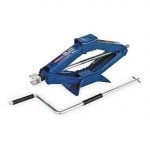
31BuEx8w-WL._SL500_AA280_Hopefully the Jack and Tire Iron that came with your vehicle are still in it. If not, it’s time to take care of that problem.

For those who could possibly be unfamiliar with a Jack and Tire Iron, a Jack is what lifts the vehicle to change a tire, and a Tire Iron is what you use to remove the bolts that hold your wheel on.

These two items are essential and without them you won’t be able to change a flat tire.

Also, be sure that your Jack is complete and in good working order. With most Jacks, there’s a rod that is used to turn the Jack to raise it. Make sure you have it!

Spare Tire

The most common vehicle problem is a flat tire, and having a proper spare tire with you can mean the difference between making it to your destination or not.

Always check your spare periodically to ensure it’s properly inflated and there’s no cracking in the rubber.

Yes, tires have shelf lives! A general rule is that a tire is only good for about five years before the rubber starts to deteriorate. This includes a spare tire that’s never been used, especially if your spare is exposed to the elements like on a truck.

So, think back to when you bought your vehicle, and if it’s been five years, replace it!

Simple Tool Kit
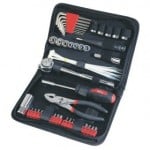
51y+PNmHVvL._SL500_AA280_Including a simple tool kit in your Vehicle Emergency Kit is always a great idea. At the very least, you should have the tools necessary to replace your battery.

A small wrench set, socket set and a pair of pliers will do most of the tasks required, but throwing in a few screwdrivers, some electrical tape / duct tape, tire pressure gauge and spare fuses will make it even better.

Fire Extinguisher
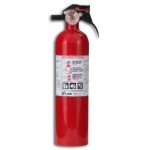
41P83BC0inL._SL500_AA280_Fire Extinguishers are an often forgotten element in most Vehicle Emergency Kits, and an item we feel is very important to have with you.

How many times have you seen a car on the side of the road that was either on fire, or nice and crispy from being on fire. It happens, and having a Fire Extinguisher with you could mean the difference between a burnt hose, and a burnt car.

There are quite a few Vehicle Fire Extinguishers that are manufactured, and even some that have a handy velcro backed bracket that will hold it in place on your vehicle’s carpet.

Fire Extinguishers made for vehicles will typically come in two different dry chemical configurations (ABC and BC), to fight different classifications of fires.

Here’s a quick primer on fire classes, using the wrong type of fire extinguisher on the wrong class of fire can make matters worse!

  • Class A: Ordinary Combustibles – Wood, Paper, Cloth, Trash, Plastics and Solids that are not metal.
  • Class B: Flammable and Combustible Liquids – Gasoline, Oil, Grease, Acetone and all Flammable Gasses.
  • Class C: Energized Electrical Equipment and Battery Powered Equipment
  • Class D: Combustible Metals – Potassium, Sodium, Aluminum, Magnesium (these require a special extinguishing agent)

Obviously carrying both types of extinguishers, ABC and BC, would be ideal, but at the least get a small ABC extinguisher made for a vehicle.

Remember that dry chemical fire extinguishers need to be turned upside down periodically to loosen up the chemical that will settle at the bottom of the extinguisher. If the chemicals become caked, the extinguisher may not discharge properly when it’s needed.

This goes for those extinguishers you have sitting around the house too. You do have Fire Extinguishers in your house right?

Emergency Signaling Device / Markers
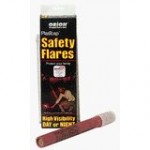
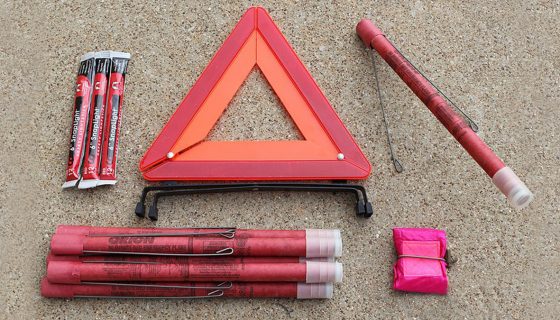
41DY6mSrOcL._SL500_AA160_.gifThe purpose of an emergency signaling device is two fold, it can be used to alert oncoming traffic to your prescence on the side of the road, and can also be used as a distress signal in an emergency.

We’re partial to Road Flares, because in addition to the two uses mentioned above, they can also be used to start a fire. Carrying another way to start a fire with you is never a bad thing in our opinion.

Other markers available include brightly colored flags (a VS-17 marker panel is perfect) and reflective items. A flag can be tied to an open hood/trunk and reflective markers can be put out in a similar fashion to road flares, marking your location.

Extra Food and Water

Carrying extra food and water is a necessity in our book. The potential of being stranded with just the items in your vehicle is a sobering reality.

Yes, most of us drive along busy suburban roads where the Quik-E-Mart is just a few blocks away, but you’re not always in that situation, especially when traveling.

And, there may be traffic along the road you’re on, but when is the last time you stopped to help a stranded motorist?

Sometimes the best plan can be to stay with your vehicle until someone finds you, and having food and water is a good thing.

Blanket

41dXeZxpjvL._AA280_A blanket is truly a multi-purpose item and can not only keep you warm in the winter, but can be used to treat victims in shock year round.

At the very least, carry a small foil-like space blanket if you’re tight on storage space. Something is better than nothing.

Rescue Tool
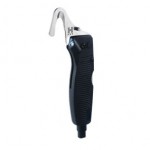
pd985The primary purpose of a tool like this is escaping from a vehicle, which in the event your vehicles takes a dive into a body of water, you’re most likely not going to be able to simply roll down the window to escape.

As the good samaritans we know all of you are, it can also be used for rescuing others that could be in a similar situation, or need to be pulled through a window to escape a vehicle.

Our choice in these situations is a dual-purpose tool that not only breaks glass, but cuts seat belt webbing.

We have a Benchmade Houdini Pro Rescue Tool that we’re evaluating right now, so far it’s a very good fit for these situations. We’ll be posting a review on it soon.

Knife / Multi-Tool
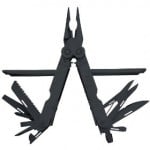
41yQDNUw40L._SL500_AA280_A good knife is an indispensable tool to begin with, and should already be part of your EDC, but like a flashlight, it’s never a bad idea to have a spare with your vehicle.

In addition to a knife, a good Multi-Tool will also come in handy and can replace needing to carry a few of the tools we mentioned above.

We’re partial to the SOG PowerLock because of its great leveraging capability and ease of use.

Extra Clothing / Gloves

Let’s say you need to make a quick run up to the store and decide to underdress for the weather since all you’ll be doing is running from your vehicle to the door.

Well, what if you get a flat on the way back and have to get out to change it? Or what if you become stranded in a disabled vehicle?

Having some gloves to keep your hands warm while changing a tire, or some extra clothing could mean all the difference in the world.

Do yourself a favor and at least toss a jacket in your vehicle.

Pre-made Kits

There are quite a few companies that produce an all-in-one vehicle emergency kits that contains most of what we’ve described here, but all of them we’ve seen are garbage.

Take our advice and build your own. Yes, you may pay more, but isn’t it worth the peace of mind knowing that you’ve bought quality items that aren’t going to fail when you need them the most?

Notes

We’d love to hear what you guys (and girls) carry with you for emergency purposes, and what you add to these basics we’ve discussed.

Even if you have all these items, this is a good time to dig them all out and make sure they’re in proper working order.

To quote the movie Spy Game, “When did Noah build the Ark? … Before the rain.”
{ 24 comments… read them below or add one }

spenceman December 6, 2009 at 12:04 pm

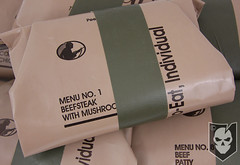
I would add a bit of food (mres, or a couple of pouches of rice and tuna, power bars, etc), also duct tape and baling wire.

Reply

Tierlieb December 6, 2009 at 12:56 pm

“The alligator clips should also be made of copper with soldered connections to the cables. Crimped connections are decent, but have the potential of coming undone.” – One of the things I learned doing electric repairs: No soldering for stuff with high currents, the solder might melt. Good jumper cables therefore should have pressed/crimped contacts.

Reply

ITS Admin December 6, 2009 at 1:03 pm

Tierlieb,

Good tip, thanks! That definitely makes sense, and we’ll edit the article with the updated information.

Reply

Jan December 6, 2009 at 1:27 pm

Great topic! It’s amazing how many people don’t even carry jumper cables in their vehicle, let alone water, tools or a blanket.

If you want to maximize your storage space and your vehicle has the spare tire mounted inside, the space inside/beneath the rim can be used to store a blanket or some clothing. Insulated coveralls stuff under there quite nicely.

re tools: don’t cheap out. If you need to make a roadside repair, odds are it wont be on a shiny new part with non-corroded bolts and as Murphy’s Law states, if it can go wrong, it will. Before I realized the importance of quality tools, I broke several sockets and screwdriver bits on stubborn bolts and screws. This doesn’t mean you need Matco or Snap-on, just don’t depend on those cheapo tools at the checkout line in Pep Boys to save the day. Oh, and it’s also a good idea to include some long socket extensions in your kit.

What do you guys think of the Gerber rescue hook (http://www.knifecenter.com/knifecenter/gerber/images/GB01943.jpg)?

Reply

ITS Admin December 6, 2009 at 1:39 pm

Jan,

Good tips! We’ve never used a Gerber rescue hook, but it seems very similar to the Benchmade Rescue Hook Model 7 we reviewed a few months back. Off hand by looking at the Gerber hook you linked to, I already think the plastic coating on the handle would be uncomfortable to hold. The rubberized coating on the Benchmade 7 Hook makes for a great grip, especially in gloves.

Thanks for the comment!
Bryan

Reply

Steve December 6, 2009 at 1:39 pm

I carry an RMJ Tactical Shrike in my vehicle at all times, it’ better than any window punch I’ve ever tried, can chop through vehicle doors and works great for firewood if stranded in the woods.

Reply

tex_blain December 6, 2009 at 1:50 pm

I agree with Spenceman on the duct tape and bailing wire but one for those that drive in dirt or snow; A Shovel! Also you forgot a basic first aid kit.

Reply

ITS Admin December 6, 2009 at 2:15 pm

tex_blain,

A shovel is a great addition to these items. It’s not that we forgot to include a first aid kit, just that we felt it was something to leave for another article. We have an article coming up on different aid bags to keep not only in a vehicle, but in the home as well. We always carry an ITS Tactical Blow Out Kit in our vehicles.

Thanks for the comment!

Reply

M. Atwood December 6, 2009 at 3:55 pm

Good stuff. I’m always amazed at the folks who carry absolutely nothing in their cars. One of the common gifts I give friends is a tool-bag, or ammo box, filled with emergency supplies for their car – Very similar to what you’ve listed here, actually.

In my experience, vehicle kits should be tailored to your environment as well. I’ve spent most of my life, from childhood, living and working an hours drive (or more) from paved roads. Simple trips into town for supplies, or that one part to fix whatever problem, can turn into multi-day ordeals if things go wrong with the vehicle.
A shovel, as noted above, is a big deal if you spend time off-road at all. And, in my experience, an e-tool is a poor choice for digging out a vehicle. A shovel with a full blade and solid construction will get you further, faster. Even a short handled shovel with a full-sized blade (you see these in a lot of the 4×4 and overland travel enthusiasts rigging).
Tow straps and removal rigging are also a must if you go off-road much at all, and I tend to keep a tow strap in my vehicle all the time anyway even for strictly urban use. Just a handy thing to have that takes up little to no space.

For tools in the car, I’m also a big fan of cheating – Augmenting one’s tool kit with one or two high value tools, in addition to the “right” tools. Vice grips are a favorite of mine.
Using vice grips for a wrench is never the right way to do things – However… Its sometimes the only way. Vice grips are a constant in my vehicle kits. You can do so much with a pair of average sized vice grips (or two pairs), and add so much functionality to the other tools by having the vice-grips there as clamps, wrenches for odd-size or stripped nuts/bolts. Also, for changing the battery, they work better than “battery nut pliers” for loosening or removing the old, corroded, generally jacked up terminal nuts.

Also, on the flashlight front – For the car, I really prefer a headlamp. Makes life that much easier when its already bad enough that you’re under the hood, or crawling around under the car itself. Also, on the incan vs. LED front – Anymore, my experience is that most LED’s actually out perform incans, particularly in tactical style lights. They offer greater brightness (and better control with multiple levels), with a more color neutral tone, with greater battery life and shock resistance.

Reply

Norm December 6, 2009 at 4:18 pm

In addition to the listed items, I also keep extra ammo for my primary pistol, cleaning kit for the weapons, a good knife, MRE’s, rope, folding shovel, binoculars, extra batteries for the flashlights, etc. as well as a basic emergency trauma kit. Few maps (topographic, road). And the ever important end all fix all – Duct tape. :)

I end up switching out items in the winter/summer – keep an extra coat in the car for winter, extra blanket. I can fit all of it in two bags, my GOOD bag and a backpack. I tend to keep an eye on the water in the car though in the winter, had an issue in the past where it froze and burst one year and MAN was that a mess.

Reply

Tony December 6, 2009 at 4:43 pm

A good reminder, but sheesh – very basic stuff isn’t it? I was hoping for an article that has a bit more “meat” on it. And while the first aid kit of a vehicle does deserve its own article, surely it could still have been at least mentioned?! I would claim it is quite an important item to have in a vehicle.

On the flash light issue, this article sounds rather dated – there are some really bright LED lights out there, nowadays. Fenix has at this time, I believe, two separate 630 lumen LED lights and the last time I browsed Lighthounds on-line selection I spotted at least a couple of 1000 lumen LED lights. (Yeah, makes ones EDC light seem so… inadequate, doesn’t it? :P ) For more “normal” lights, a 200+ lumen LED is pretty normal. The only thing the incandescents have over most LED lights is the color of the light – if you’re trying to follow a blood trail, the cold blue light most LEDs put out make the red blood more difficult to see than a light with more neutral white output. But outside of hunting use (and there are neutral white LEDs too), I’d say the argument between incandescents and LEDs was settled sometime by 2005 at the latest.

Oh yeah, and you did not mention batteries. Alkaline batteries do not like the cold at all. You’ll want to run lithium batteries in a spare flashlight, those are less (but not entirely) immune to temperature changes, and have a much longer shelf life.

As for asking what I carry for emergency purposes… Where does one draw the line? :) A CB radio can certainly help in case the local cell phone network loses coverage (and there’s another item for your list: cell phone charger), but is used for other than emergency use. Pen and paper is a fairly obvious thing to have in ones vehicle – and again, most likely used for mundane things.

Still, let’s see… A shovel, an axe, a saw, a knife. Jack and tire iron, of course, but also a lenght of 2×4 to place under the jack – comes in handy on uneven and soft ground. Tow straps, clevises. (Proper tow points on the vehicle, naturally – and the time to figure out where they are and if they are durable enough for recoveries is before they are needed.) Spare tire. Compressor. (A cheap POS that I hopefully will be able to replace soonest. Finding decent compressors in this country is, unfortunately, something of a challenge, and nobody seems to sell the good stuff internationally over the Internet.) Alas, a winch is too expensive for us, but a mechanical come-along / ratchet will be added soon. A jerry can, empty usually but full if we know we’re heading out somewhere without frequent refueling points. (Driving in very poor conditions – off-road type driving like in heavy snow fall – can consume a lot more fuel than what you normally need for a given distance!) A nozzle for the jerry can – this is important! The first time you try to refuel from a jerry can you’ll see for yourself, but until then, just trust me mmkay? First aid bag, including some fairly basic stuff and additionally a bunch of chemical lights. (Handy little things for marking stuff in the dark – patients in a care situation, vehicles, whatever. Especially handy since road flares are a no-no here, and also useful for not setting stuff you’re trying to mark on fire. :) ) Duct tape, water, MRE entrees and other food obviously. Esbit stove with fuel and other fire making instruments. (Both ignition methods and tinders. This is one thing where multiple redundancy is a very good thing!) Fire extinguisher, naturally, but also a blanket made for that use. A metal container that can be used to melt snow or ice, or to boil water. CB radio in the vehicle, hand-held PMR radios for mobile short range comms. Spare batteries for the walkie-talkies. Spare fuses for the most critical components of the vehicle. Space blankets, rain poncho liners, rain ponchos. Paracord, bailing wire. Aaaand a whole bunch of odds and ends that I am probably forgetting. :)

Reply

Tony December 6, 2009 at 4:54 pm

…Darn. And now I wish I had an edit-button I could press. Reading back my post, I can see points where my attempts of humor can be mistaken for an condescending attitude. (Why yes, I know quite well I am not the first person in the world to refuel from a jerry can…) Not my intention at all.

I hope those who read my comments remember that English is a second language to me. It is also rather late over here.

Reply

Ben December 6, 2009 at 5:56 pm

Add a 1st Aid Kit, a map of the area you travel in, and a list of phone numbers you may need and you are good to go.

Reply

NEWWT55 December 7, 2009 at 9:14 am

i try to keep a roll of quarters. it’s small and i sometimes do not carry a lot of cash. also it helps if you were ever to find a payphone (though these have become hard to find objects in a lot of places).

Reply

DRIVEPEN December 7, 2009 at 10:52 am

The timing of this is right on the money as we just received about 8″ of snow overnight here in the Reno/Sparks area of northern Nevada. Been here several years now and have had similar kits in all my vehicles since the first drive in the snow.

Reply

Rex Dart December 7, 2009 at 11:01 am

Always carry at least a quart of oil, and automatic transmission fluid, and a gallon of antifreeze or 50/50 mix. If you do have a fixable leak, having replacement fluids can allow you to drive to help, vs. waiting for it.

Most modern vehicles use a single serpentine belt to connect the engine with everything else under the hood, including the critical items like the alternator and water pump. Strongly consider carrying a replacement belt in your vehicle kit, just in case.

Depending on the length of your trip, and the distance to help (try driving through western North Dakota some time, very lonely) carrying replacement hoses for the radiator might be worth while.

Bottom line, keep up on regular, planned preventative maintenance on your vehicle, and many breakdowns can be avoided altogether.

Reply

Angry Pirate December 9, 2009 at 12:06 pm

How about a shovel or entrenching tool?

Reply

Tony December 9, 2009 at 2:26 pm

I’d definitely go for at least a hiking shovel over an e-tool, if possible. A full size shovel would of course be the best, but those tend to be fairly large, so perhaps not a reasonable item to carry unless you have a large vehicle or do serious off-roading. Of course, an entrenching tool is better than nothing (and when I drove a small sedan, mine saved my butt from more than one spot of trouble!) and some take very little space, but they are kind of short. On second thought, e-tools can be more useful as a pick, to chop planks into firewood and other such tasks (to give a few examples I have used mine for) than a light-weight hiking shovel though, so… I guess it’s a good thing I carry both these days. :)

Reply

steven December 9, 2009 at 2:43 pm

Keep a decent breaker bar in the vehicle, the ones supplied with your vehicle are normally low quality and will either be too short or round off when you try to change the tyre. If you take your vehicle to a garage then the wheel nuts will normally be done up with an air tool, and normally too tight at that, its surprising how such a important tool normally gets overlooked. This simple piece of equipment is worth its weight in gold when your in a situation you dont want to be.

Reply

DukeDog December 9, 2009 at 4:46 pm

i would like to add a comment about the tire changing equipment that comes from the factory with vehicles. if you drive a truck or SUV (like i do) and have ever had to change a tire with that piece of crap jack they give you with the car then you can share my frustration. the first thing i did was replace it with 3-ton hydraulic bottle jack. they make it so much easier to change a tire, however i have left the factory jack in its compartment in my SUV for redundancy (”two is one and one is none”)

Reply

Steven Baum December 15, 2009 at 5:10 pm

I am of the school of thought that “one is none & two is one”.That being the case I have a backup for all safety net stuff in my home & my vehicle.I like the ColdSteel shovel as it can cut down a tree,open a car [ cuts metal ] and can even dig a hole,and as I also travel across the Canadian border – its the only weapon that is a tool [ LOL ] and as to the fire extinguisher = it too is a GREAT weapon as to stopping the ability to breath/see and as a impact weapon too.Just KNOW that you had better be totally justified in the use of such force,or say hello to your roomate Bubba.The list is not complete for me without a source of heat,candle’s and a small stove fit in my truck with ease.Wool blankets and a real first aid kit as well as was mentioned TOW good lights & food & water [ freezes in the winter here ].My list is more extensive but this is a good start,as you got the basics !!!!.

Reply

seth belt December 15, 2009 at 6:34 pm

i didn’t read all of the long comments so i may be restating here but i never go any where without the ability to make fire.

a great fire kit is a magnesium block that has the fling and striker on it and a ziploc bag filled with dryer lint. that stuff is the best tinder that costs nothing except clean clothing.

Reply

seth belt December 15, 2009 at 6:35 pm

so i fail at self-editing. the block should have *flint* not *fling* for anyone who didn’t catch that.

Reply

John Longo December 29, 2009 at 1:10 am

90% of life is what you have on you! Flashlight, fighting/cutting knife, phone, gun (I carry a North American Arms 5 shot ,22 magnum mini revolver as a back-up- so small you’ll never forget it, yet effective!

Reply

Leave a Comment

« Previous post ITS ETA Kit Feedback

Next post » Remembering Pearl Harbor