




How to Make a Fast Rope for Climbing

by August 6, 2010 08/6/10
1 of 3 in the series Make a Fast Rope

We’ll be taking a different approach to our Knot of the Week Series for the next three weeks, as we bring you a few articles on creating your own Fast Rope for Climbing.

Fast Rope Insertion & Extraction Systems (FRIES) provide safe and efficient methods for inserting and evacuating personnel to and from specific targets. Fast Ropes come a few different ways, which is with an eye splice or a metal ring for hook up to the davits found on some helicopters.

They’re also available with and without the loops for extraction. As this KOTW is for creating a climbing rope, we’ll be creating a Fast Rope with an eye splice and without extraction loops.

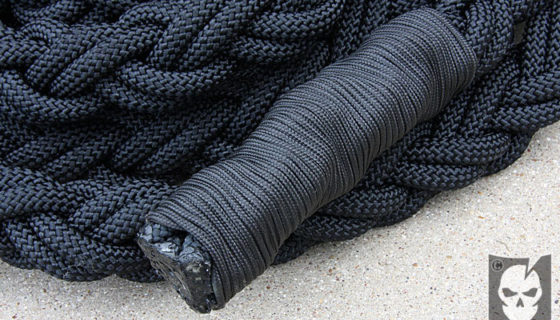
Today we’ll be getting into how you create the 4-Strand Round Braid that’s used to braid a Fast Rope, followed by instructions in the coming two weeks on eye splicing the Fast Rope, and either back splicing or whipping the bottom end.
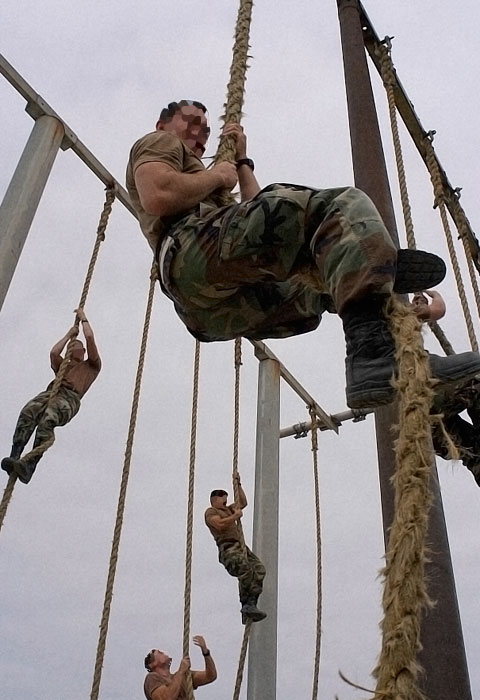
Why a Fast Rope for Climbing?

First of all if you’re not climbing a rope, you’re missing out on one of the best forearm and grip workouts around. Climbing a rope is at the core of the Functional Strength discussions we’ve had here on ITS. While we’ll save the reasons and methods for climbing a rope for a later article, let’s just say it’s an important thing to train and could save your life.

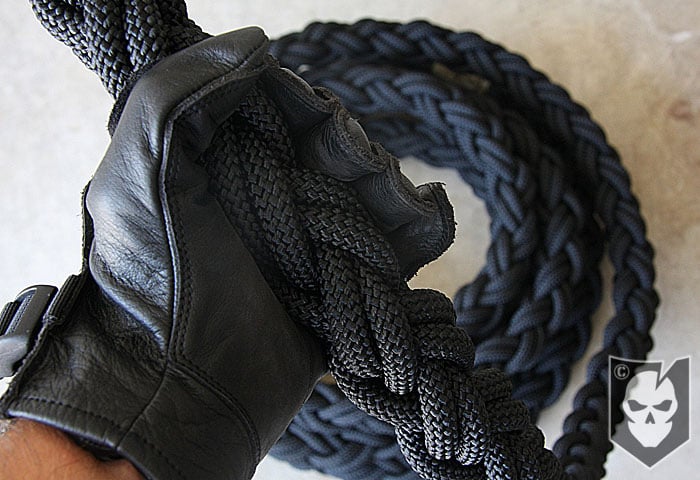
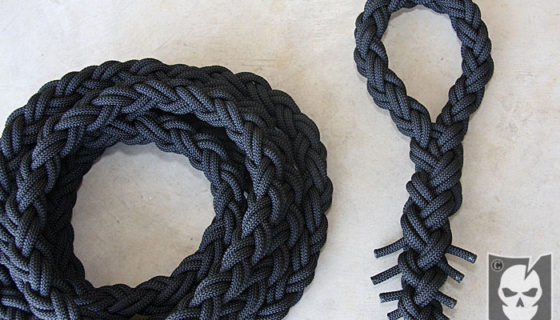
The reason that a Fast Rope is braided with a 4-Strand Round Braid, is to reduce overall kinking and create an outer pattern that’s easier to grip versus a smooth rope. This also aids in controlling the descent on insertion. That outer braided pattern also makes a great grip when ascending a Fast Rope. If you haven’t had the pleasure of climbing an old Fast Rope that’s been converted into a climbing rope, it’s so much nicer to climb.

Climbing a Fast Rope is not a military technique, and not commonly practiced. Climbing in the military is typically done with a Caving Ladder, or in PT scenarios with Manilla Ropes. While Manilla Ropes are great to climb, they become frayed, slick and can leave splinters in your hands and other parts of your body if you’re not careful when descending.

Purchasing a Fast Rope is out of most budgets, as one of these can run anywhere from $750 to $2000, depending on the length. Professional Fast Ropes for the Military are also made with machines, braided very tightly and almost impossible to identically create. What we’ll show today is not a professional Fast Rope, and isn’t a substitute for one. However, it is a great climbing rope and is equally as strong as a professional Fast Rope provided you use the rope and braiding technique we recommend.

Creating a Fast Rope

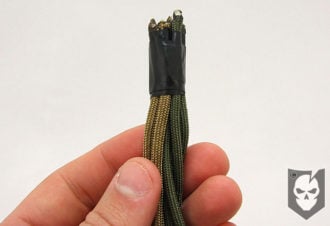
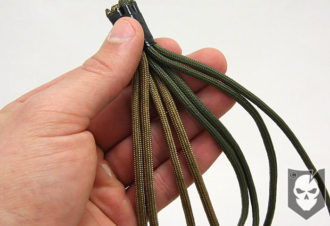
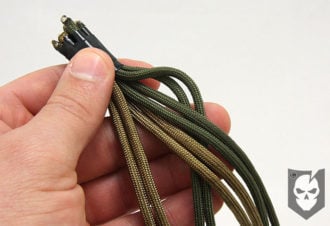
As mentioned above we’ll be demonstrating the 4-Strand Round Braid today, which is the first step in creating a Fast Rope. The rope we built was created out of 8 – 35ft. strands of 7/16″ Bluewater Assaultline Static Rope. This is where you’re asking yourself “Why did they use 8 strands when it’s a 4-Strand Round Braid?” The answer is because each of the four strands in the braid is doubled.

We used Bluewater Assaultline Static Rope because we wanted something that was equally as strong as Military Fast Rope. With the four doubled strands used in construction, our Fast Rope has a 28,000+ lbf (pound force) or 129 Kn (kilonewtons) rating, and using an authentic eye splice was the strongest and safest method of terminating the line. An eye splice develops approximately 85% of the break strength of the line, and enables the rope to be girth hitched onto a beam to climb.

You don’t have to use assaultline for your climbing rope, as it was around $200 for the length we purchased. We do recommend that you use static rope though, dynamic rope has too much flex to be used for climbing. If you need to use Nylon rope for cost considerations, use a Solid-Braid Nylon. We don’t recommend Nylon for climbing rope though, as it’s fairly slick when it comes to your grip.

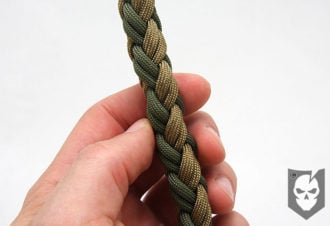
Why 7/16″ rope? Because four strands of 7/16″ equals the standard Fast Rope diameter of 1 3/4″. We actually came up with the calculation by using paracord, which is how we’ll demonstrate the 4-Strand Round Braid today. Paracord is 1/16″ in diameter and our completed 4-Strand round braid with paracord came out to be a 1/4″ in diameter, so we knew that using a 7/16″ rope would give us the required 1 3/4″ diameter we were looking for (7/16″ x 4 = 1 3/4″). 7/16″ rope is fairly close to 11mm if you need that conversion.

If you’re interested in the Mil-Spec construction for Fast Ropes, they follow MIL-F-44422, which talks about everything from material to length (standard lengths are 60, 90 and 120 feet). Here’s something straight from the specification: “Construction: 1.75 inch (44mm) diameter made from Low stretch nylon fibers with a 8 braid construction to reduce rope kinking and afford fast, fully controlled, and safe descents.”
Instructions

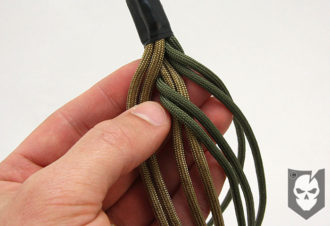
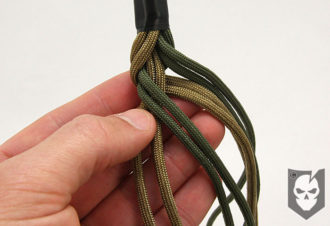
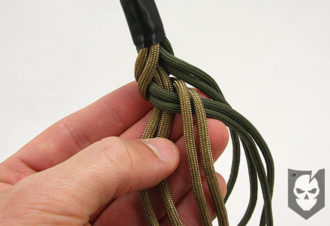
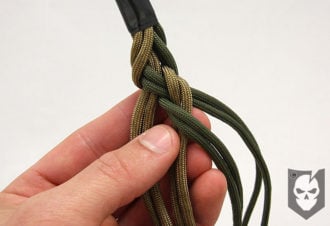
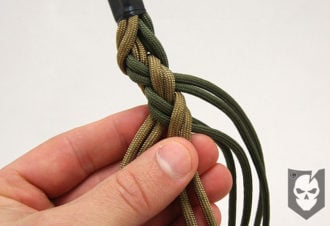
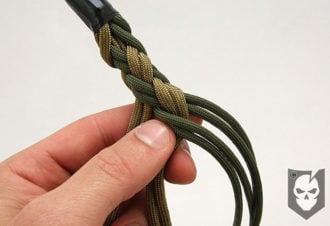
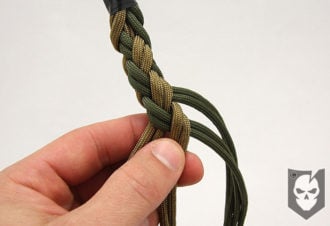
Fast Rope 14We highly recommend that when starting this project, you practice the 4-Strand Round Braid with Paracord or other small line to get your technique down. It’s a bit different that a traditional braid and nearly impossible to explain in words, which is why we created the video below.

A great mnemonic device for learning the braiding pattern is “back two, over one.” What you’re doing is alternating from the right to left outside pairs while taking the respective working end around the back side of two strands and over the last one it’s brought behind. This of course won’t make sense until you watch the video, but reciting this pattern will help you stay focused, because you’re in for a long braiding session.

It took two of us around an hour and a half to braid our Fast Rope. We started with 35 ft. strands and wound up with a 25 ft. long Fast Rope that weighs approx. 16 lbs. You can estimate needing around 1.5 feet for every foot in length you want your Fast Rope to be. That’s also not including the length required for the eye splice and whatever method you use for terminating the end (future article).

You’re also going to definitely need a buddy to help you braid, as creating this pattern plays havoc with the standing ends of the rope. They’ll develop twists that your buddy will have to fix, because you’ll be braiding and won’t be able to let go of the rope. You could do this by yourself by taping the braiding every foot or so to go back and untwist the lines, but you’re in for a long day if not many days.

Braiding this Fast Rope is also a tremendous grip workout in itself. You’ll have to be tightening the braid while keeping it together and is not for the weak-fingered individual. If you are, find a friend with a good grip and be the one that untwists the lines and buys the beer.

Video and Photos

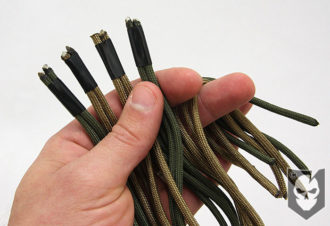
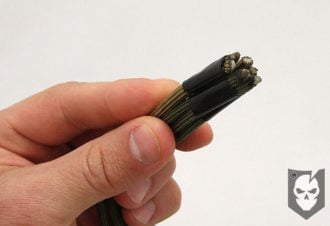
We’ve not only included a YouTube video on how to tie the 4-Strand Round Braid, but tried to accurately describe the process with photos as well. Remember that we’ll be back to show you how to complete your Fast Rope with and eye splice and terminating method in the following two weeks! We’ll be demonstrating rope climbing techniques in a future article that will help you learn this skill-set.
Fast Rope 01Fast Rope 02Fast Rope 03Fast Rope 04Fast Rope 05Fast Rope 06Fast Rope 07Fast Rope 08Fast Rope 09Fast Rope 10Fast Rope 11Fast Rope 12Fast Rope 13Fast Rope 14Fast Rope 15

Building a Fast Rope for Climbing: Part 2, 4-Strand Eye Splice

Building a Fast Rope for Climbing: Part 3, Whipping and Fusing

A special thank you to CENTCOMSurvivor from our Forum for initiating the conversation that brought you this article. Creating a Fast Rope for Climbing is something we’ve wanted to do for a long time, but was pushed to the side until recently suggested.
Are you getting more than 14¢ of value per day from ITS Tactical?

Please consider joining our Crew Leader Membership and our growing community of supporters.

At ITS Tactical we’re working hard every day to provide different methods, ideas and knowledge that could one day save your life. Instead of simply asking for your support with donations, we’ve developed a membership to allow our readers to support what we do and allow us to give you back something in return.

For less than 14¢ a day you can help contribute directly to our content, and join our growing community of supporters who have directly influenced what we’ve been able to accomplish and where we’re headed.

Click here to learn about all the benefits and Join!


45 Comments

  • Orion says:

    Great article. $200 for 8 35 foot strands of this rope is a lot cheaper than actually buying a 30 foot rope. Ive seen them for as cheap at 1500 bucks. $200 is a great price!

  • William Harvey says:

    after finding this site while looking for knot tying videos I have really come to appreciate this site’s content and purpose. But after watching this extremely cool video and future projects concerning this knot, I just had to write and say keep up the awesome work man! Your site rocks!

  • jon says:

    would this rope be good enough, i dont know if its solid braid or not but it is in accordance with the military manual; http://www.uscav.com/Productinfo.aspx?productid=9492&TabID=548

  • Bryan,
    Much thanks for putting this together! Its great to see you take a forum question and answer it in awesomeness.
    This is just what I needed to help me figure out how to make a climbing rope for my backyard gym.
    Keep up the great work!
    Eric S.

  • Graham Monteith says:

    I don’t know how ITS Tactical does it. Me and my bud were talking about this not too long ago and we both wanted to buy some fast rope but the price was crazy. This helps alot! I hope to try this in the near future!!!

  • Mike says:

    Great instructions! Would you consider a series on how to fast rope, much like your ones on rappelling?

  • nukefaith says:

    Abso-fucking-lutely AWESOME. Crossfitters in Berlin Germany will thank you for this!

    Thank you!

  • Bryan, I took a mile high look at this yesterday and retweeted it for you. Today I actually dug into it and I have to say one of your coolest projects to date!

    This pattern gives me some pretty interesting ideas even just using it with paracord.

    • Thanks Jack, glad you liked it. Of course the 4-Strand Round Braid is nothing new, but I’ve never seen a “How To” on Fast Rope construction.

      There’s a 4-Strand Flat Braid that would be good for Paracord as well.

  • I figured I’d buy some of the cheap rope mentioned to make a practice rope for our kids last night.
    My awesome wife watched the video and went right to work. Since this was for the kids we made four 50′ ropes and looped them at the top making each 25′ (not the correct method I know). I taped them together and my wife did all the braiding.
    Being the “rope untangler” was lots of fun and I had to be quick to keep up.
    One thing we found that helped was having my wife sit on the floor (indian style) and keep one of the rope strands (two ropes) on her right side and the other on her left. The other two strands I kept out to the sides and kind of angled to the front.
    This helped her keep track of where she was at and once you get a rhythm going it went pretty quick.
    We did have to stop once and we both forgot where we were and had to start over. What ever you do DON’T STOP!
    Anyway I hope that might help and I cant wait to get some nice rope and make another one.
    Eric S.

  • Cervantes says:

    We aren’t allowed to erect structures without a permit in my neighborhood, but I think my kids will be climbing some home made fast rope on grand daddys oak tree.

  • Daniel Meek says:

    Thanks for a great DIY. I have been considering buying a 1.5″ climbing rope, but now I may have to make my own.

    I was searching on ebay for a good deal on static rope and ran across a couple of postings for used fast rope. What do you think about buying a used fast rope… at 80′ it is probably a little long?

    Can’t wait to see the rest of this series.

    Daniel

    • Daniel, that’s definitely too long if you’re just using it as a climbing rope. You should build your own and you’ll be able to make it the exact length you need.

      Thanks for the kind words,
      ~ Bryan

  • Jason says:

    I made a 12″ paracord rope and it sure is nice. However is it normal to have it a bit ‘lumpy’ here and there? Overall pretty decent looking but some weaves are a bit tighter or looser – should I not worry about that?

    As a side note, one of these out of paracord will make a nice dog leash or bracelet. I’ll have to show the kids in my Cub Scout pack.

    Thanks again ITS.

    j

  • Brad says:

    Bryan, I read that you said nylon rope can be used to help lower the cost, but you don’t recomend it for climbing? Not sure I understand this, are you kinda saying if you have to use nylon, due so at your own risk? I was thinking of giving it a try just to keep the cost down. Static line is a bit pricey for me right now. Great article.

  • Martin says:

    I just read the article on how to climb a rope like a Navy Seal.

    for those of us without a vehicle or a place to hang a fast rope at home, how much does the fast rope that you made weigh Brain, a rough guest is all I am looking for.

  • Greg says:

    Great segment!

  • Tim says:

    Just curious, but first amazing article!

    Going out today to purchase supplies to make one.

    I dont understand the 8 strand thing, as 8 x 7/16 would be a 3.5 in diameter rope….?

    Also an idea, use 2 strands, find the middle of both, throw a carabiner through it, fold over and tie the 4 strand braid, no need to make an eye splice.

    Thank you again for such a great website and article

  • timc says:

    This is fantastic. Thanks. I did find these instructions on the internet which made it slightly easier. Take a look.

    -Count the strings from one to four, from left to right.
    -Begin by crossing the second string over the first and the third string over the fourth. You should see two “X” patterns formed with the four strings.
    -Cross the new second strand over the new third strand to create an “X” in the middle of the four strings and then begin the pattern again.

  • timc says:

    feel free to delete my above comment from june 2. i began to make the rope with those instructions and, although it works very fast, it creates a flatter braid more suited for girls hair, not a fast rope. it’s generally helpful for me because I have two daughters with long hair, but won’t work to create the rounder rope we are shooting for based on your instructions. sorry!

  • Tightey Whiteys says:

    Awesome kick-ass directions, as usual!

    Made a ~6 foot test version out of black/olive paracord to get the hang of making the braid. My 8 year old daughter thought it was cool and has since commandeered it as her new jump rope with her friends…

    When I get the $$$ to afford ~400 feet of static line I will build my fast rope! W00t!!!

    Cheers,

    -Julian

  • Steve says:

    How essential is it that the braid is super tight? I had a 3 person team braid 8 50′ strands of rope. It took us two hours, but as I’m sitting here making the eye splice, I feel like it’s just a little too easy to double up the braid. I do NOT want to unbraid and re–braid the whole thing again. How big of an issue is it? Is it a safety issue? The rope is loose enough that I can fairly easily pinch off any strand of the braid and fit a finger through the hole… help!

  • Gorgeoth says:

    The four-strand round braid is a great idea, and I realize my suggestion is a little more complicated, but would a six-strand braid allow me slightly more texture for grip, when I use the line (rope) for ascending and descending?

    I’m going to have to build myself a 20 ft length out of paracord, first your way, then extrapolate to 6-strand, just to see.

    Excellent item!

  • Andross says:

    I am excited to make a Fast-Rope, but wanted to use the 1000 feet of paracord I have lying around.

    What do you reccommend I do as so that I can get it up to a more reasonable diameter? Should I double up twice? Should I add more strands for weaving (or can you only use four)?

Leave a Reply

Your email address will not be published. Required fields are marked *

You may use these HTML tags and attributes: <a href="" title=""> <abbr title=""> <acronym title=""> <b> <blockquote cite=""> <cite> <code> <del datetime=""> <em> <i> <q cite=""> <strike> <strong>

The Latest
Squawk Box