




Knot of the Week – Common Rope Seizing

by June 1, 2010 06/1/10

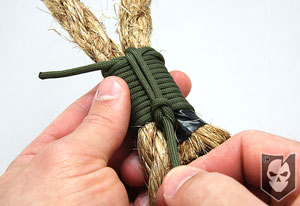
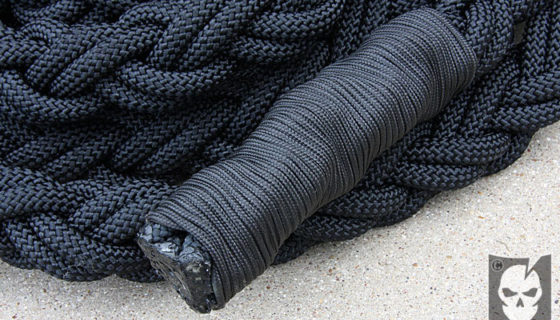
In today’s Knot of the Week, we’ll be showing you how to use common seizing to join two parallel pieces of rope.

Seizing can be a great alternative to knotting or splicing, but is not as strong as a dedicated splice. For instance, in the article demonstration we’ll be creating an eye with our seizing. While a good method, it’s nowhere near as strong as a splice.

Terminology can get a bit tricky as this appears to be a lashing, but lashings are typically defined as the joining or binding of timbers. While seizing even starts the same way as a lashing, with a Clove Hitch, they’re technically different.

Another nugget of terminology here is that the last turns through the center of this seizing are referred to as Frapping.

Common Seizing » Lashings

(Strength: 3/Secure: 2/Stability: 2/Difficulty: 3)

Please refer to our Knot of the Week introduction post for a description of what these ratings mean.

Uses:

  • Joining two parallel sections of rope
  • Technique carries over to Lashings as well

Tying Instructions:

  1. Create a closed loop and bind the two sections of rope with a Clove Hitch (a constrictor knot can also be used).
  2. With the working end, make a series of tightly wrapped turns below the Clove Hitch (at least 12 turns).
  3. On the last turn, just wrap around one section of rope and bring the working end up between the two sections of rope.
  4. Tuck down through the loop with the working end creating a frapping.
  5. Do this once more to create two frapping turns.
  6. Tuck the working end through the right-most frapping turn.
  7. Cross over the frapping turns, making a loop before tucking through the left-most frapping turn.
  8. Pull the working end tight, creating a Square Knot in the seizing.
  9. Trim the excess as needed and fuse.
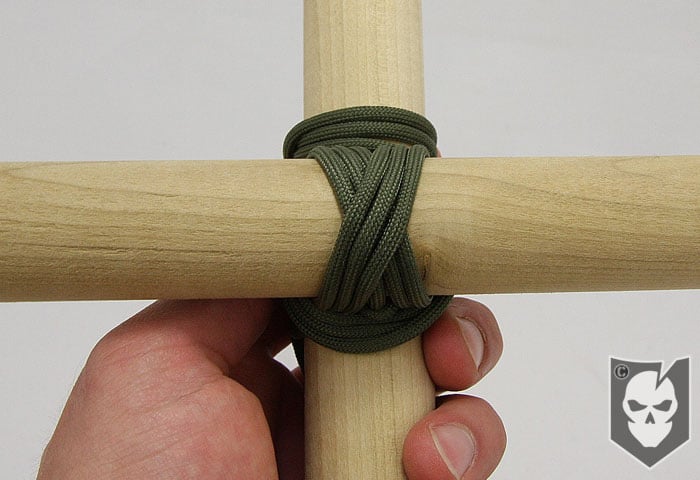
Common Rope Seizing 01Common Rope Seizing 02Common Rope Seizing 03Common Rope Seizing 04Common Rope Seizing 05Common Rope Seizing 06Common Rope Seizing 07Common Rope Seizing 08Common Rope Seizing 09


Are you getting more than 14¢ of value per day from ITS Tactical?

Please consider joining our Crew Leader Membership and our growing community of supporters.

At ITS Tactical we’re working hard every day to provide different methods, ideas and knowledge that could one day save your life. Instead of simply asking for your support with donations, we’ve developed a membership to allow our readers to support what we do and allow us to give you back something in return.

For less than 14¢ a day you can help contribute directly to our content, and join our growing community of supporters who have directly influenced what we’ve been able to accomplish and where we’re headed.

Click here to learn about all the benefits and Join!


7 Comments

  • Justin says:

    What would be the benefit of using this over say a figure 8 on a byte, or a bowline for a dedicated loop?

  • Justin, definitely not. While seizing has it purposes, it should not replace applications requiring a loaded loop.

    Thanks for the question!

  • Justin says:

    To me, tying a bowline, or a figure 8 on a byte is faster, I was just curious as to where using seizing would make more sense than tying a load bearing knot.

  • Essentially it makes more sense in a non-load bearing situation and in a situation where you have to have the rope parallel and a knot would be too bulky, to name a few.

    Hope that helps.

  • beelzububba says:

    Justin,

    Not a perfect example, but it will give you an idea of what Bryan is referring to:

    Think of the halyard (rope) on an extension ladder. The rope connects semi-permanently to the fly section of the ladder (the part that moves up and down). You do not want a knot in this section, as it will bind with the rungs of the ladder as it is raised or lowered, causing difficulty in raising the ladder, or making it impossible to raise. You also risk causing the knot or even the rope its self to fail, causing a dangerous situation. Granted, as Bryan indicated, a splice is highly preferred to seizing, but it can work in a pinch.

    See an image here of a spliced rope connection on an extension ladder (upper left corner):
    http://www.modelfireapparatus.com/resources/equ

  • Adam, that's a great example. Thanks for the addition to the comments!

  • This technique is useful when dealing with a very thick manila rope which is used for climbing. A proper eye splice on that thick a rope is very difficult.

Leave a Reply

Your email address will not be published. Required fields are marked *

You may use these HTML tags and attributes: <a href="" title=""> <abbr title=""> <acronym title=""> <b> <blockquote cite=""> <cite> <code> <del datetime=""> <em> <i> <q cite=""> <strike> <strong>

The Latest
Squawk Box