




How to Escape from Zip Ties

ITS Article Image
by September 26, 2009 09/26/09

In our How To Escape and Evade in an Urban Environment article, we briefly discussed escaping from zip ties.

There are quite a few hasty methods of illegal restraint, and zip ties are a method that’s available to any would-be kidnapper.

A few of the other methods seen are duct tape, rope and phone cord, but with a little education you’ll see that all of these methods can easily be defeated.

There are two things you’ll need in any escape situation, and without these two things, nothing we’ll show you will work.

Those two things are time and opportunity. You’ll have to first have the time to be able to put one of these escape methods into action and the opportunity to do so.

Your captors are most likely not going to have the resources or the patience to keep eyes on you constantly, and when they don’t, it’s time to make your move.

How Zip Ties Work

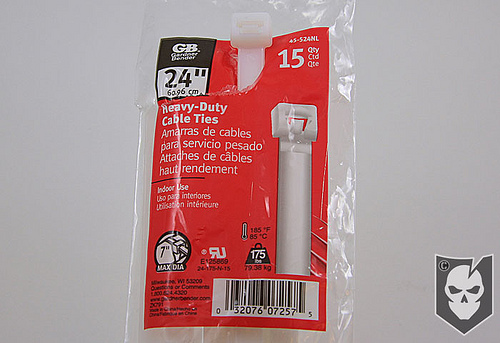
Heavy Duty Cable TiesThe best way to defeat any type of restraint is to first analyze how it works.

Zip ties consist of a sturdy  Nylon tape that contains small teeth running lengthwise down one side, and a  ratchet with small teeth housed in a small open  case.

The ratchet is molded to allow downward pressure to be placed upon it as the tape is threaded through the open case, then springing back up to position as the valleys of the tape align with the teeth of the ratchet, locking the zip tie.

At this point further forward movement will continue to tighten the zip tie, and backwards movement will lock it.

The particular zip ties we used in all our demonstrations were the most heavy-duty zip ties we could find at Lowes or Home Depot, the Zip Ties shown in the photo with a 175 lb. rating.

We chose these because realistically if someone was determined to go out and buy zip ties to use to illegally restrain someone, they’d likely hit the local hardware store and find the toughest ones they could.

To defeat zip ties, you can either completely break the zip ties, shim them, use a friction saw or with a little forward thinking just be able to slip right out of them.

Breaking Zip Ties

Breaking Zip Ties (Rear)

Shimming Zip Ties

Friction Sawing Zip Ties

Slipping Out of Zip Ties

Dual Zip Ties

Hand Positions

Hand Positions

Now that we’ve gone over these four methods in detail in the videos, let’s talk briefly on how you’ll be bound, because it’s equally important as the method you choose to escape.

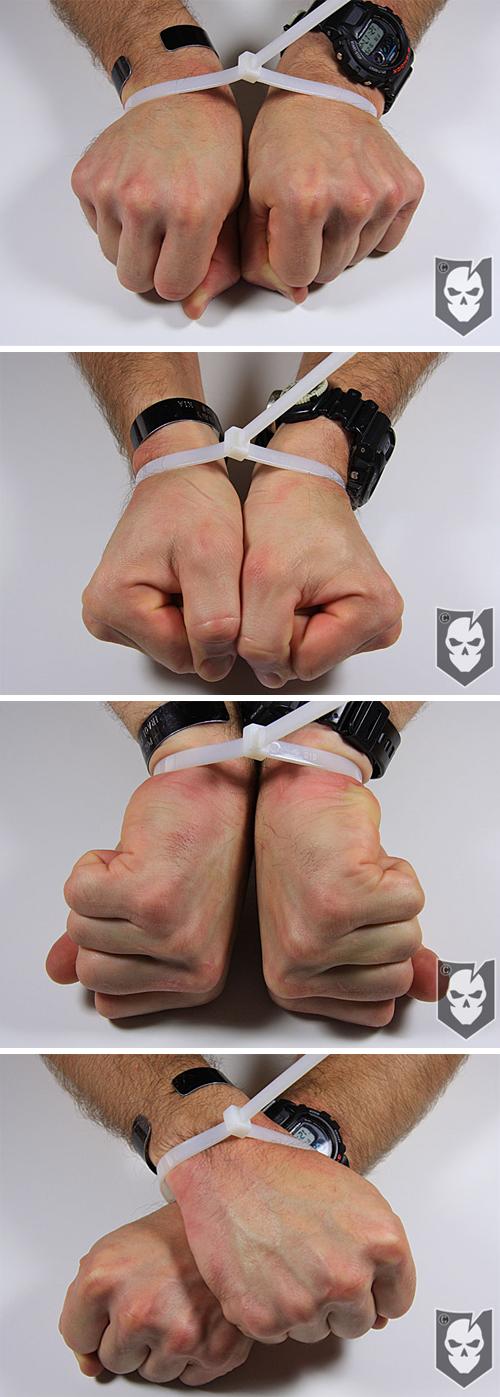
For an exercise, so that we’re all on the same page, put both of your hands straight out. Now touch your wrists together. This will be called “wrists together, horizontal.” This position is the easiest to escape from by slipping out.

Next rotate your wrists so your right hand turns clockwise, your left hand turns counterclockwise and your wrists touch. This will be called “wrists together, vertical.” This position is not preferred, but as shown on the breaking videos, can be defeated.

Now, from the “wrists together, vertical” position, rotate your hands so the backs of them touch together. This will be called “wrists together, inboard.” This is the hardest position out of the four, but can still be defeated by breaking.

The final way you could be bound is by crossing your hands at the wrists, making an X. This will be called “wrists together, crossed.” This position is a bit harder than the first for slipping out of, but it’s still possible.

Passive Victim

The first thing you should always do in any restraint situation, is remain passive.

Let your captor know that there’s no fight in you, that you’re scared and helpless. This will psychologically lead your captor to believe that you have no plans to try to escape, and thus make what we’re about to tell you easier.

You want to make every effort to present your hands to your captor before they use force to restrain you. Essentially you’re presenting the wrist position of your choosing to them, hoping they’ll use it.

Notes

Using the information we’ve provided to your advantage, you can put yourself in a better position to escape or determine which of the methods presented will work best in your circumstances.

We hope at the very least you watched the videos we’ve made, so you have the information stored somewhere in your mind, tucked away just in case you ever have to use it.

Let us know your thoughts and any questions you still have about escaping illegal restraints.

UPDATE 3/9/2010: We’ve just released this article explaining our position on the content of this article and why this information is important to get into the public, in the article we also talk about an important safety alert on a product called Jersey Cuffs. More Here.

Update 5/28/2010: Restraints we’re proud to endorse!


Are you getting more than 14¢ of value per day from ITS Tactical?

Please consider joining our Crew Leader Membership and our growing community of supporters.

At ITS Tactical we’re working hard every day to provide different methods, ideas and knowledge that could one day save your life. Instead of simply asking for your support with donations, we’ve developed a membership to allow our readers to support what we do and allow us to give you back something in return.

For less than 14¢ a day you can help contribute directly to our content, and join our growing community of supporters who have directly influenced what we’ve been able to accomplish and where we’re headed.

Click here to learn about all the benefits and Join!


248 Comments

  • kodagashi says:

    This is the good stuff! Well described and I feel (after a bit more practice) I can teach this to my guys!

    Thanks!

  • Brian Palmatier says:

    Another easy way to escape zip ties, and one I commonly teach my soldiers, is to remove a shoelace, tie a knot in each end, and use the lace streched between your feet and your mouth, to saw the zip ties. Any cord will cut through even the most rugged zip tie in seconds. Hands have to be up front for it to be quick.

  • Brian Palmatier says:

    Sorry, just saw the video on my previous post.

    • ITS Admin says:

      Brian,

      No worries. Good point about needing for your hands to be in front to be quick, but the friction saw method can also be used with your hands behind your back. Just a bit more confusing and should be practiced to ensure success.

      Thanks for the comment!

  • Tackleberry says:

    Some of the best info I’ve found!

    Already forwarded it to my buddies overseas and elsewhere. ;)

  • rkuntz says:

    A question:

    I think it’s certainly possible that the bad guy is going to use two zip ties linked together as field expedient handcuffs.

    Obviously the shimming and friction methods will apply to those situations as well, and maybe that’s just the best approach. But both of those methods do take some time and require a little privacy. So is there a break method that works for that setup?

    • ITS Admin says:

      rkuntz,

      Absolutely! The same break method as we’ve described in the article will work for handcuff style zip ties as well. The trick is to try and maneuver the locking mechanism on each zip tie to the area between your wrists. Even if you can’t do that, with enough force they’ll break just like the others.

      Thanks for the comment!

  • Tackleberry says:

    I know you guys stated why you used the zip ties that you did, but have you guys tried using any of the methods against the Monadnock brand single and double flex cuffs?

    A couple of buddies I forwarded this to had similar questions.

    • ITS Admin says:

      Tackleberry,

      We have. True Flexi-Cuffs are a different ball game, and we’re coming up with how to present that information to the masses.

      Thanks for the comment!

    • TheDoof says:

      Don’t forget to demo the ASP style Tri-Fold restraints, if you’re going that route… might as well be complete.

    • ITS Admin says:

      Doof,

      We’re working on the article on other types of restraints, but for the purpose of this article it’s complete. The most typical zip-tie-like restraint used in an “illegal” situation will most likely be Zip Ties, the likelihood that criminals have access to ASP Tri-Folds or other police style restraints is slim. Not impossible, but slim.

      Thanks for the comment!

  • Tackleberry says:

    Can’t wait. You guys are great when it comes to exploring all the angles of topics.

  • I have a bunch set of Monadnock disposable cuffs I’m working with. I don’t think the body snap attack will work against them to well, they are stout and I believe more pliable then the standard zip tie. Shimming is possible, but a pain in the ass due to the construction and tension on the locking mech. That being said you can cut through the things with either kevlar cord, or the white inner cord of paracord. I found that the whole paracord was just to big to create an effective cutting edge.

    • ITS Admin says:

      That’s what we found with them too Jesse. Good info, and I liked that you wrote about the metal insert now showing up in flexi-cuffs to prevent a friction saw.

      Thanks for the comment!
      Bryan

  • Chris says:

    Very informative, thank you. I think if I were to restrain someone, I would use a smaller tie and zip together the ring fingers at the base knuckle. Do you think the above methods would work to escape from restraint of this type?

    • ITS Admin says:

      Chris,

      Yep, all that it takes to defeat any kind of zip tie is to defeat the locking bar within the tie. By using a smaller tie you’re actually making it easier to defeat.

  • Doc says:

    Superb work Gents! One question re: the shimmy method. Who is the .com supplier mentioned? Despite turning up the volume it is hard to discern the name of the company. Thanks!

  • Ray says:

    Terrific, very useful info! Thanks and regards, Ray

  • Arnþór says:

    What if you were tied with your wrists together and the fingers on right hand pointed towards left elbow and fingers on left hand pointed towards right elbow?

    • ITS Admin says:

      Is this a trick question? LOL If you mean simply having your wrists crossed, you’d use the slipping out method we show in the video above. If not, you’ll have to be more specific.

      Thanks for the comment!

  • John says:

    To use a shoelace to saw through the tie, better than removing a lace and tying a knot in each end is to tie a knot in the end of one of the laces while still in the shoe. Free the other end and pull the knot up against the eyelet, then tie a knot in the free end and tuck it between your teeth. Your shoe gives you a firm hold on the foot end.

    • ITS Admin says:

      John,

      Having an end in your mouth does not give you the same friction cutting power as bicycling your feet does. I’d almost guarantee the method we’ve described will get you freed much faster. With a little practice before potentially winding up in this situation, pulling a lace out and tying the knots is quite simple. You should be able to do it with your eyes closed.

      Thanks for the comment,
      Bryan

  • Verbsare Happening says:

    And, what about tactical restraint cuffs…

    http://www.monstermarketplace.com/Sports/Landing3060a666.html or the like, stronger, reinforced against pry or break…

    Also, I’ve seen these used on the thumbs v. wrists. I think the force required to break a 300lb-rated nylon restraint would break the first metacarpal…

    But, please, show me how…

  • Geno says:

    Good information. Thanks!
    Why don’t you use the end of the Zip Tie to shim? Fits good has a narrow end and is strong like a fingernail.
    Works good and is available, usually can be reached with fingers.

  • Excellent videos and presentation.

    Best,

    Chief Pocock

Leave a Reply

Your email address will not be published. Required fields are marked *

You may use these HTML tags and attributes: <a href="" title=""> <abbr title=""> <acronym title=""> <b> <blockquote cite=""> <cite> <code> <del datetime=""> <em> <i> <q cite=""> <strike> <strong>

The Latest
Squawk Box