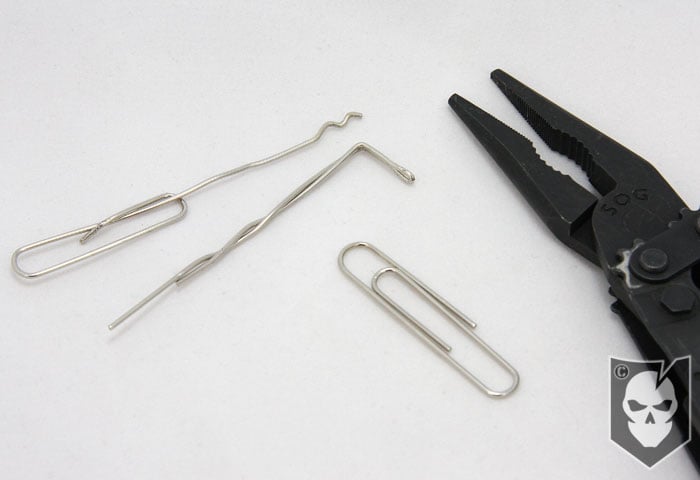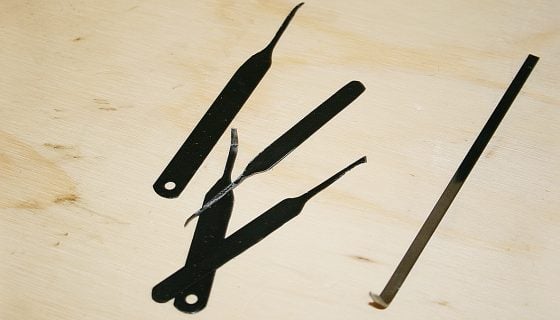





Today we’re going to show you how to create a Lock Pick Rake and Tension Wrench using two simple paperclips and a Multi-Tool.
As we’ve mentioned in previous Lock Picking articles, the Rake/Tension Wrench is the most versatile combo to carry for bypassing standard pin/tumbler and wafer locks.
In our last Lock Picking article on the SerePick Bogota Entry Toolset, a lot of people commented that they were unable to purchase Lock Picks, and couldn’t get involved in learning the skill-set.
After today, you’ll have no excuse not to make your own simple picks, buy a cheap padlock and work on your raking technique. In fact, while we demonstrate creating a rake, you could also make a feeler pick to start learning how to “feel” the individual pins and how they move/bind under tension.
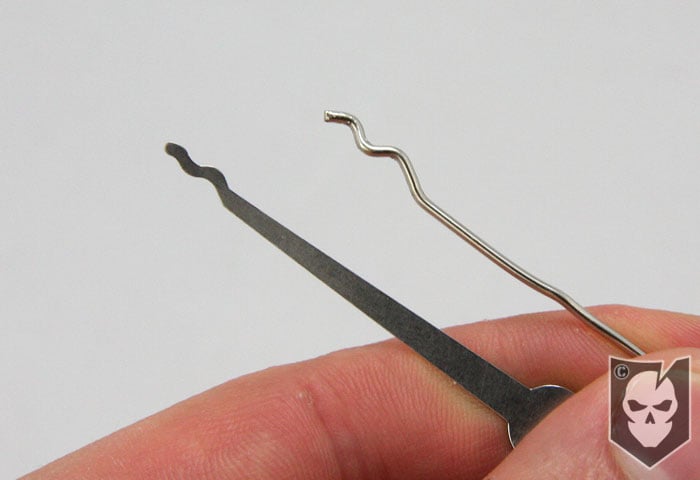
Materials
The first thing you’ll need is a supply of larger paperclips. These that we’ll be using are not the standard small paperclips, but the larger versions. One will be needed for the Rake and one for the Tension Wrench. As you’ll see in the video below, it’s easy to snap these as you’re bending the rake.
This will happen if you bend one direction, and then try to re-bend it in the opposite direction. If you keep to a single bend direction though, these will last a long time and remain strong.
A Multi-Tool works the best to create the necessary bends and twists for the combo. You’ll be mimicking the bends of a “C” Rake, and the right angle of a tension wrench with the second paperclip.
Creation
Rather than try to explain the bends and twists, we’ve created a video that will help show you a hands on demonstration of the creation and successful bypass of a pin/tumbler lock. This DIY combo will take a bit longer to use than a standard Rake/Tension Wrench, but nevertheless just as effective.
Please let us know in the comments if you have any questions regarding creation or use and we’ll be sure to answer them.
Notes
We encourage everyone reading this article to get involved with lock picking as a skill set through various lock sport groups such as Toool and Lock Sport International. There’s a large community out there of people who understand the value of this skill-set and also like to have fun picking locks.
Here’s the Lock Sport code of ethics, which sums things up nicely:
“You may only pick locks you own or those you have been given explicit permission to pick.”
Lock sport is an honest, ethical, and legitimate hobby. Unfortunately, the whole world hasn’t figured that out yet (though we’re working on it!). Because the lay person has a tendency to perceive what we do as somehow nefarious, it is extra important that we commit to following a strict code of ethics. For this reason, the above credo is non-negotiable in the locksport community. Lockpicking should never, ever be used for illegal or even questionable purposes. Please do not misuse this information. We assume no responsibility for your actions, and in no way condone immoral activity. Help keep locksport fun for all by following strictly the one rule.
Are you getting more than 14¢ of value per day from ITS Tactical?
Please consider joining our Crew Leader Membership and our growing community of supporters.
At ITS Tactical we’re working hard every day to provide different methods, ideas and knowledge that could one day save your life. Instead of simply asking for your support with donations, we’ve developed a membership to allow our readers to support what we do and allow us to give you back something in return.
For less than 14¢ a day you can help contribute directly to our content, and join our growing community of supporters who have directly influenced what we’ve been able to accomplish and where we’re headed.


{ 32 comments… read them below or add oneDiscuss in our Forum }
Great topic for today. More DIY projects such as this are needed- and would be appreciated. Thanks for the info!
Thanks Mark! We’ll keep em’ coming!
I personally have had much more success with shallower bends in the rake. It makes it easier to get in and out of the lock, and it seems to help it slide across the pins more smoothly. Just a note.
Eric, good tip. I can definitely see where that would be more beneficial. The bends I used were definitely larger than necessary, and probably added to the time it took to get the lock open in the video.
Awesome article. Would’ve used this last week. Thanks for another great article
Thanks Trebec, glad you found it useful!
Great Video! I have personally made some picks out of T Pins as well as paper clips goofing off at the office and they work well too.
I just did this with my apartment lock and it worked within 20 seconds of me starting, so cool!! Great design!
Just getting started in lockpicking myself and used this article yesterday to lock and unlock the cabinets at work last night with a couple paperclips. Good times!
Just got an email from “Red” with a link to this article.
“I want to learn!”
Thanks Bryan for leading my wife down the dark path ;-)
Great topic I cant get enough of the DIY stuff. Thanks!
I used the shallower bends and it works great. ( first time ever lock picking and it worked). You guys have great how to”s and info on awesome gear. Keep up the good work!
Think anyone will notice all the large paperclips missing from work?
Nah!
I was at work today and I have a lot of 5200 series American locks and for the life of me I couldn’t seem to open it, I know I got all the pins to click but the lock wouldn’t open. Any suggestions?
American locks have security pins in them to try and protect against picking. They are going to be near impossible to pick with raking. The pins have grooves cut into them that will catch on the sides of the lock when you try and pick it. So it may “feel” like all the pins are set but they are actually caught on the grooves.
Ex.
http://i282.photobucket.com/albums/kk265/slozinsky/DSC00308.jpg
You need to learn single pin picking to tackle a American lock.
I have a few american locks series 1105s’s any idea how to get the plugs out of these?
great vid! now i ican go open that shed that i lost the kiy too!
Great article.
I have an antique wooden desk that has been locked for ~20+ years. The keyhole looks more like a skeleton key like you see in old houses. Any suggestions how to pick it?
Thanks
-PaulK
Surley you can just kick the door down assuming its your house?
Just used this concept with small key rings. It worked outstandingly and saved I saved my T.C. the headache of finding bolt cutters.
Thanks!
Works like a charm on my back door! Thanks for sharing.
i love tactical pick locking style ! hahaha
WORKED FIRST TIME!!! I have just found a new hobby.
Glad to hear! Thanks for letting us know.
Thanks now i can get into my house when i lose my key
Awesome post. I quickly made my initial tools as shown in the video. However, I wanted to point out that it is quite easy to construct several other popular pick styles. I made a rounded half diamond tip which seems to work super fast on standard dead bolt locks. Also, try tweaking the tension rod design: make the tip wider by wedging a small flat tip screwdriver in the fold at the tip. This made a little stronger and wider tension tool.
Great video!!!!
I wish I had this video when I had to learn how to pick, instead I had to work hours just to practice!!!
Tried this, and it took longer to make than it took to open
thanks…Keep posting
Thanks for the feedback and support!
This is great. I already fashioned up a few sets of my own. I do, however, have a few questions.
1.) Do these lock picks work on deadbolt locks with throwbolts?
2.) On the “C” Rake, how big (in length and width) to the ridges have to be?
Thank you very much for the great videos and for showing me my new hobby.
-Adam
After watching this vid i decided to put two paperclips in my wallet, just in case.
Came in real darn handy when i got locked out of my hotel room :D
even first time ever lockpicking, it only took 10-15 minutes to open
thanks ITS!
Awesome feedback Vinni! Glad they came in handy!
Thought I would tell you about my experience trying to pick a lock using paper clips. As background, I have never picked any lock. Never even tried. However, I recently saw something on picking on the internet that interested me. I began to read about how to pick locks and decided I wanted to buy a set of picks and give it a try. While I was deciding what picks to buy, I continued to read about lock picking and came across your video on how to pick a lock using just paper clips. Up until then, everything I read online said newbees should not waste their time trying to use ‘office supplies’ to pick locks. “Too frustrating!” “Movie fiction. Can’t be done.” However, you did it in your video and it looked like it couldn’t be simpler. I had the paper clips and in short order, a little longer than it took you, I had the required ‘tools’. My pick had more gentle curves than yours but that seemed OK since one comment to your video suggested the problems you had picking your lock may have been due to the steeper curves. Anyway, I had the tools and I now needed a lock.
The only unused lock I could find around the house was a padlock I had used 2-3 years ago to lock the gate at the end of the driveway. It was used only one season because in the winter, the lock froze. Almost everyday that winter, I had to use a cigarette lighter to thaw the lock. Not fun at sub-freezing temperatures in the dark before sunrise. I did not have any anti-icing compounds so I finally tried pouring some olive oil in the lock. It worked for a day or two but I eventually had to go back to the cigarette lighter. Repeated the oil treatment a couple of times but always had to resort to fire. The lock eventually got shoved into the glove compartment and forgotten. When I found the lock yesterday, I could not find the key. Thus, I had no way of knowing whether the lock would even work. What the hell. I would give it a try anyway. I figured I would try for an hour or so to open the lock. I expected that I might have to put more time in later. I also foresaw that I would probably be mucking around with the lock while I watched television for the next few nights. I was prepared to be patient. So, I followed your video as best as I could even though I had no idea what I was doing. I was raking, sawing, jiggling, bumping, whatever. After a minute or so, I began wondering what was happening. I stopped torturing the lock and eased off on the tension and distinctly heard a ‘click’. I interpreted that to mean that I had set one or more pins. I was encouraged and went back to work. It couldn’t have been a minute more and the lock popped open. I was stunned! Since then, I’ve repeated this dozens of times. My fastest time was less than 10 sec with several other times of under 30 seconds. What was the lock, you ask? It was a Master padlock that had ‘Kryptonite’ written on a plastic waterproof wrapper. The only writing actually on the padlock was ‘ 40 MM’. No doubt, this lock is probably THE EASIEST lock to pick in the entire world. Nevertheless, I’m impressed and still somewhat stunned about how easy it was.
Thought you might be interested to hear a virgin’s attempt to pick their first lock. Thanks for the video.