




Check out the ITS Online Store for awesome new products!

email
share

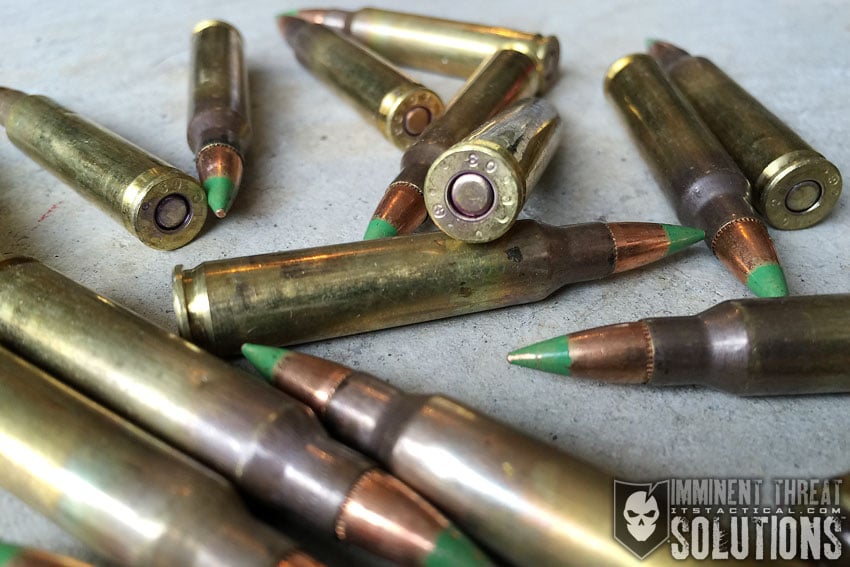
Military Ammunition and Why Green Tip M855 is Not Armor Piercing

by Bryan Black on June 6, 2011

email
share
Post image for Military Ammunition and Why Green Tip M855 is Not Armor Piercing

Over the weekend I attended the final hours of my NRA RSO (Range Safety Officer), Rifle and Shotgun Instructors training. While I won’t get into the NRA’s embargo on the word “weapon,” or that a few instructors freaked out when I carried a firearm with the muzzle pointed at the ground, I did learn something from our readers on Facebook I’d like to share with everyone.

Throughout my time in the Military, I’d always referred to M855/SS109 5.56 Ammunition (Green Tip) as armor piercing rounds or AP. For the life of me I can’t recall where I first heard that mentioned, but it was fairly common for it to be referred to as that.

One of the final taskers for the NRA courses was to construct a training aid and you’ll see a photo below of what I put together.

Armor Piercing?
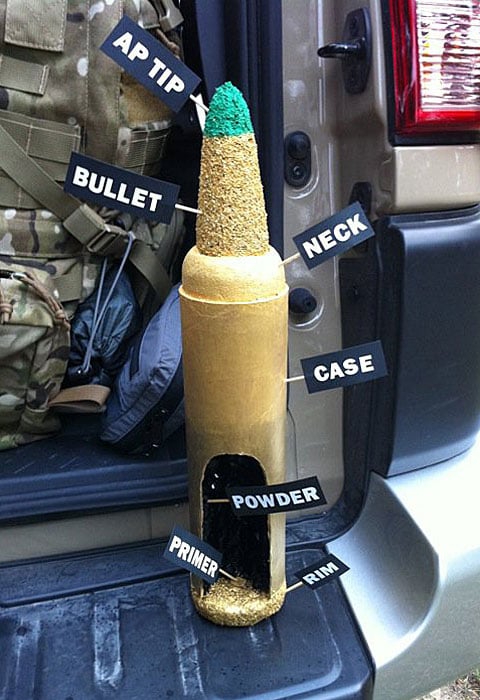
M855 Ammunition Training Aid As you’ll see, I have the green tip marked “AP Tip,” which is how I explained my training aid to the class as well. (If you’re wondering, it was made from a cardboard tube, floral foam, paint and a little creative thinking).

After a few people pointed out that M855 isn’t AP in the Facebook comments of the photo I posted, I started doing some digging. It turns out that sure enough, M855 was removed from the ATF’s list of AP rounds. I haven’t been able to track down when this change took place, but I thought it was important to share to all those that have considered M855 to be AP rounds like I did.

While having a Steel Penetrator Tip, this doesn’t constitute M855/SS109 as “Armor Piercing.” The round was designed for increased penetration at longer ranges to combat SAW (Squad Automatic Weapon) issues though.

Things may or may not be clearer once you read how the Federal Government defines AP ammunition in 18 USC sec. 921(a)(17).

Definition

(17)(A) The term “ammunition” means ammunition or cartridge cases, primers, bullets, or propellent powder designed for use in any firearm.

(B) The term “armor piercing ammunition” means-

(i) a projectile or projectile core which may be used in a handgun and which is constructed entirely (excluding the presence of traces of other substances) from one or a combination of tungsten alloys, steel, iron, brass, bronze, beryllium copper, or depleted uranium; or

(ii) a full jacketed projectile larger than .22 caliber designed and intended for use in a handgun and whose jacket has a weight of more than 25 percent of the total weight of the projectile.

(C) The term “armor piercing ammunition” does not include shotgun shot required by Federal or State environmental or game regulations for hunting purposes, a frangible projectile designed for target shooting, a projectile which the Attorney General finds is primarily intended to be used for sporting purposes, or any other projectile or projectile core which the Attorney General finds is intended to be used for industrial purposes, including a charge used in an oil and gas well perforating device.

What does all that mean?
A few things to take note of is that the classification as “armor piercing” is for bullets only, not the complete cartridge. Despite the mention of handgun caliber above, you can take that to mean that it’s a round that has been made as a handgun caliber at some point.

The bullet (projectile) must also have a core made entirely out of the metals listed above, or be a full jacketed bullet with a jacket weighing more than 25% of its overall weight. This means that the SS109/M855 bullets wouldn’t be covered, as their cores are partly steel, and partly lead. Lead isn’t listed in the metals above. Furthermore, as you’ll see in the list below, the ATF has specifically stated that the SS109/M855 bullets are exempted from AP status.

ATF AP Classified Rounds

  • All KTW, ARCANE, and THV ammo
  • Czech made 9mm Para. with steel core
  • German made 9mm Para. with steel core
  • MSC .25 ACP with brass bullet
  • BLACK STEEL armor and metal piercing ammunition
  • 7.62mm NATO AP and SLAP
  • PMC ULTRAMAG with brass bullet (not copper)
  • OMNISHOCK .38 Special with steel core
  • 7.62×39 ammo with steel core bullets

ATF Exempted Rounds

  • 5.56 SS109 and M855 NATO rounds, with steel penetrator tip.
  • .30-06 M2 AP ammo

Hopefully that clears up some confusion for you like it did for me. You can rest easy that when a range calls for no AP rounds that you’ll be safe using M855 if desired. If you’re in the market for ammo, be sure to check out our sponsor Lucky Gunner for great online ammo prices!

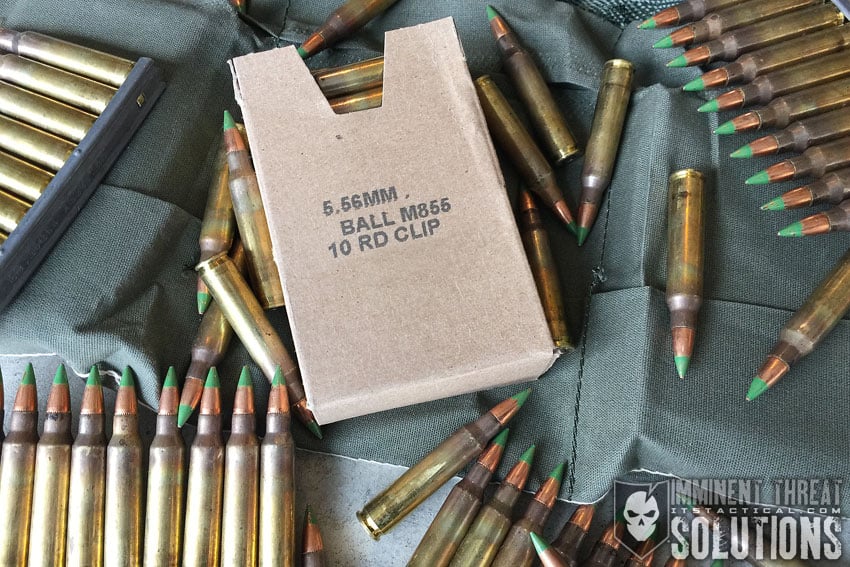
M855 Ammunition Training AidM855 SS109 Green Tip Ammunition
email
share

Are you getting more than 14¢ of value per day from ITS Tactical?

Become a Crew Leader!

Please consider joining our Crew Leader Membership and our growing community of supporters.

At ITS Tactical we’re working hard every day to provide different methods, ideas and knowledge that could one day save your life. Instead of simply asking for your support with donations, we’ve developed a membership to allow our readers to support what we do and allow us to give you back something in return.

For less than 14¢ a day you can help contribute directly to our content, and join our growing community of supporters who have directly influenced what we’ve been able to accomplish and where we’re headed.

Click here to learn about all the benefits and Join!

{ 2 trackbacks }

SayUncle » Armor piercing ammo
June 15, 2011 at 8:59 am
Why Green Tip M855 is Not Armor Piercing « Police and Tactical Gear
June 15, 2011 at 11:09 am

{ 23 comments… read them below or add oneDiscuss in our Forum }

ssggfield June 6, 2011 at 4:50 pm
Thumb up Thumb down 0

They have a steel core not “tip” I have dug plenty of these cores out of shoot house walls. Although I have heard multiple reasons why this round was adopted, one being that it was able to punch through combloc soft armor and helmets better with the steel core. It doe’s how ever not fragment as well as M193.

[IMG]http://i682.photobucket.com/albums/vv189/ssggfield/steelcore003.jpg[/IMG]

Reply

Peter G. June 6, 2011 at 5:22 pm
Thumb up Thumb down +2

I really wouldn’t assume that these rounds are safe on “NO AP” ranges. The laws of man bear no particular relationship to the laws of nature. Always ask the rangemaster.

Reply

Jasper Pettit June 6, 2011 at 5:25 pm
Thumb up Thumb down +1

So, wait… The .30-06 M2 AP rounds that the NIJ uses to test Level IV plates isn’t considered armor piercing by the ATF. That seems odd to me.

Reply

Oh ATF considers it AP. The key word here is EXEMPT. The listed AP ammo is the stuff that’s not allowed to be sold to regular (non gov’t.) folks. M855 and .30 M2 ball (great round) are exempt because of their use in NRA High power/ service rifle matches.

Reply

Matthew Baxter June 6, 2011 at 5:55 pm
Thumb up Thumb down 0

I stopped using Green Tip ammo after having sever malfunctions with it. The most serious being a round got caught between the bolt face, the gas Key on the carrier and the top inside of the receiver. It took my gunsmith 2 hours to get it out because he had to take the barrel off since the BCG was partially in the buffer tube preventing a normal breakdown. The gunsmith said he has only seen this 3 other times in his 30+ year career and every time it was from Green Tip

Reply

Jesse V. July 14, 2011 at 11:45 am
Thumb up Thumb down +2

Believe it’s the “bolt override”. There’s actually an easy field fix.

http://www.youtube.com/watch?v=jzY9jLeI0BU

It’ll probably never happen to you again though. haha

Reply

Wayland June 7, 2011 at 2:26 am
Thumb up Thumb down +3

In addition to the steel core segment not composing the entire core, it also isn’t hardened in most M855. Please note that each DoD M855 source (Lake City, Olin, IMI, Privi Partisan) produces distinctly different M855. Primarily the differences in bullet construction are worthy of note. Thicker jackets, harder lead, and different weight distribution of the core can greatly change the wounding effect, among other things.

It is worthy of noting that M855 will generally not penetrate any barrier that M193 will not penetrate inside of 100yds. The increased barrier penetration at distance has more to do with energy retention, sectional density and stability differences. The steel has more of an impact due to stability changes from moving the projectiles center of mass rearwards.

If your range cannot safely handle M855 inside of 100yds, your range isn’t safe with M193 either. And the difference at distance isn’t spectacular.

If I wasn’t posting from an iPhone and lazy, I’d provide more info on M855.

Wayland.

Reply

We’ll see how well this goes over with my GMC next time I’m at the range.

Reply

Not for use on steel plate targets. Still fails the magnet test.

Reply

I have made many IPSC steel targets out of ar500 steel (1/4″ thick)
Works fine on my targets… just expensive

Reply

Zachary Gomrick June 20, 2011 at 10:49 pm
Hot debate. What do you think? Thumb up Thumb down -2

I’m an active duty U.S. Marine. The green tip rounds we are issued for our M16′s are simply 5.56 FMJ BALL rounds. Completely standard issue, nothing special about them. If it has an ORANGE tip, it is a tracer round, and BLACK tips are armor piercing. Make sure you know the difference if you buy Milsurp ammunition. Hope this clears things up.

Reply

this article was pretty good up until the very end:

” You can rest easy that when a range calls for no AP rounds that you’ll be safe using M855 if desired. ”

the ATF AP definition is intentionally doctored to exclude ss109 simply because of the ramification of slapping all that regulation on our armed forces bread-and-butter bullet. a range master doesn’t give two sh*ts about that. he cares about his establishment and fact remains that the m855/ss109 does what it design to do – punch through barriers and wears out backstops far better than a conventional lead core bullet.

Reply

Ghillieman December 29, 2011 at 5:04 am
Well-loved. Like or Dislike: Thumb up Thumb down +5

Zack, fellow devil dog here, the 5.56 ball you are issued with the green tip does have a partial steel core in it. Next time you go to a live fire range take a magnet with you and touch it to the green tip, remember that only ferrous metals, like steel, are attracted to magnets. Also, when your at the rifle qual range and your pulling butts look on the ground by the impact berm. Those little steel cores are all over the ground, they look like tic-tacs.

Reply

I’ve tested 855, 193, 7.62 NATO, and 308 win fmj head to head at 25m in steel and aluminium. In 3/8″ thick steel plate 193 and 7.62 MEN94 left craters the same depth of about half the thickness of the plate, the 855 left the same crater but the steel penetrator continued on poking out the back. 308 150gr fmj blew straight through. The steel penetrator tip is a cone the size and shape of the green painted portion, it seems to go twice the distance into every medium I’ve put it in compared to the rest of the bullet and m193. The crater is same between the two til the 855 comes apart then it leaves about a .17 cal hole beyond that point.
So it may not do what black tip ap will do but it does do more than std ball. We were surprised that it out penetrates 7.62nato (smaller hole though).
I’ve never encountered a range with ammo restrictions, but from what I’ve gathered about them they use a magnet to test. M855 have steel and will fail that test just like Russian lead core ammo which has a bimetal jacket attracts a magnet and isn’t ap. Not all that attracts magnet is steel core and not all that is steel core is ap. But I think the rationale for those rules is fire danger, I’ve seen vegetation catch fire multiple times from steel projectiles, they spark on rock and steel.
As for hardness the penetrater in m855 is far harder than the mild steel core in Russian 7.62x54r surplus which mushrooms similar to lead at over 300m, 855 retains It’s shape, unless it hits stone.

Reply

Excellent analysis Bill!
These are the tests that silence those who speak much & know little about SS109.

Reply

Murph from Polk City FL. Do I have any friends out there? By the way, unless you are using a tac sling that lets you drop your carbine or rifle on your chest, using a muzzel dwn ASfrican carry is faster then a muzzle up carry…Murph

Reply

while they are not AP, they make a divot in a steel plate twice as deep as a standard FMJ

Reply

Frank E Paton III February 11, 2012 at 10:07 am
Thumb up Thumb down 0

The M855 will still penetrate a 1/4″ steel plate

Reply

The new m855a1 is likely to be classified as ap, it has more steel and the lead has been switched to copper.
It’s suppose to penetrate better and yaw more reliably, although that seems to be counter intuitive, you can’t argue with results though. I just know from 4″ thick aluminium that standard 855 goes through, while steel core surplus 5.45 x 39 ( which is noted for yawing) goes sideways and stops in alittle over an inch. So It’s interesting to hear it does both…though 5.56 fragments rather than staying together like 5.45, so they aren’t quite comparable I guess.

Reply

Stephen Forrest March 22, 2012 at 6:44 pm
Thumb up Thumb down 0

I went 10 years in NSW and didn’t see a “bolt over” until about two years ago. Running a range one day we had three in three different weapons. Yes, one you know how it is an easy fix.

Reply

Chuck_Finley June 29, 2012 at 3:24 am
Thumb up Thumb down -1

The way it was explained to us when we transitioned to the M16A2 waaaay back in the good old days, the M855 & M856 rounds were developed with a steel core post to better stabilize the bullet when fired from the newer M16A2/M249 which were designed with tighter 1-7 barrel twist ratios over the older M16/M16A1′s looser 1-9 twist. The older M193/M196 round could be safely fired (though with some reduced accuracy) from the newer M16A2, but the M855 was not recommended for use in the older series of rifles.

Reply

The general rule (some guns may stray), is the heavier the bullet and the shorter the barrel the faster the twist needed to stabilize the projectile.
With 223/5.56, 1:12-14 is good for upto 50gr, 1:9 for 55-69gr, 1:7-8 for 62gr & up. The m16 started with 1:14 and either 52 or 53gr(can’t recall which) but soon changed to 1:12 & 55gr. Then 1:7 & 62gr came with m4. 1:9 is the most common civilian Ar15 twist rate.
It’s always been about balancing accuracy and tumbling, stabilized bullets are accurate but over penetrate and don’t yaw or tumble causing cavitation. Heavier bullets penetrate and stay on course better at distance.

Reply

I am not an expert on this, but have personally seen kevlar panels used in AV’s that were fully penetrated by M-855 ammo. These same panels stopped 7.62 x 39mm rounds, but did not stop 7.62 x 54 mm rounds.

Reply

« Previous post

Next post »