





Are You As Fit As a World War II GI?
Are You As Fit As a World War II GI?
Editor-in-Chief’s Note: This post was written by Brett and Kate McKay and originally ran on The Art of Manliness.
Have men these days “gone soft?” Is our generation less manly than past generations? Are we less tough than our grandfathers?
I see guys debate these kinds of questions all the time. Of course it’s hard to quantify “toughness,” but there is one area where we can definitively say we’ve slipped—the Army fitness test isn’t as hard as it used to be.
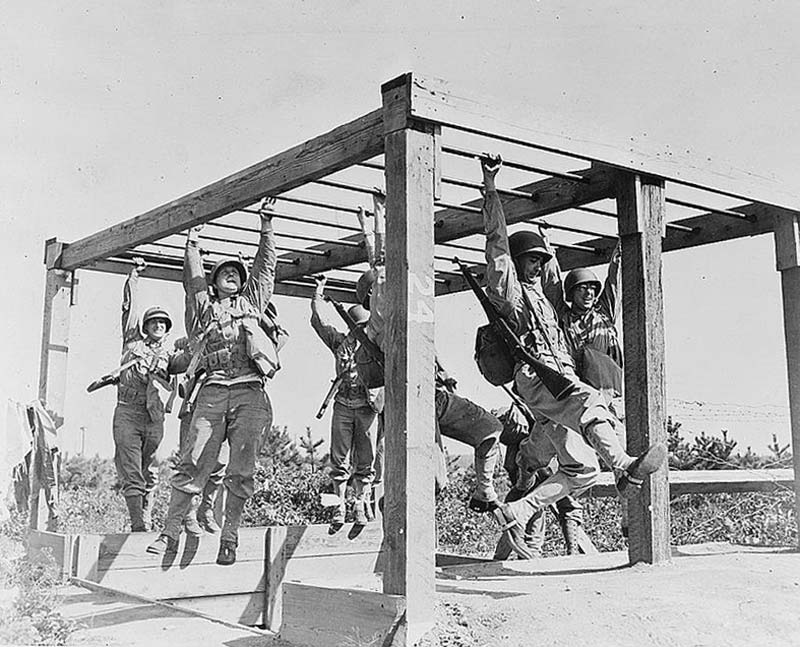
The Army first introduced a formal fitness test to the troops in 1942. Millions of men were being called up to fight in World War II and not all of them were prepared for the rigors of combat. To get the men in fighting shape, the Army implemented a systematic physical development program as part of the Combat Basic Training course. The Army Ground Forces Test was designed to assess whether the program was having its desired effect. The test included squat jumps, sit-ups, pull-ups, push-ups and a 300-yard run. The emphasis was on functional fitness and giving American GI’s the strength, mobility and endurance they would need to tackle real tasks on the battlefield.
In 1946, a Physical Training School was created at Fort Bragg with the mission of exploring how to take the goal of functional fitness farther. The training program developed at the school and the fitness test were codified in the 1946 edition of FM 21-20, the Army’s physical training manual.
Basically, Grandpa was doing Cross-Fit before it was cool.
In 1953, the Physical Training School closed and its focus on combat readiness was lost; in the ensuing decades, the military began to concentrate more on general fitness, focusing on aerobic over anaerobic exercises. The fitness test was revised several times during the 60s and 70s and standards began to be assessed on a sliding scale based on age and gender.
In 1984, the Army Physical Readiness Test was introduced and it continues to be used today. It has only three elements: sit-ups, push-ups and a two-mile run. In 1987, General Schwarzkopf became concerned that only 5% of soldiers were able to achieve the highest score on the test, so the standards were eased and more provisions were made for age and gender.
Also, whereas soldiers who failed the test used to be discharged, this rule has been greatly relaxed.
For the past couple of decades, many critics have said that the physical fitness standards for the troops are too easy and more importantly, don’t assess the kind of skills soldiers actually need in our current conflicts. In a time of new equipment like body armor, men are humping large loads for long periods and are much more likely to be sprinting and crouching than running for miles at a time.
When Dr. Edward Thomas, an instructor at the Army Physical Fitness School, re-discovered the WWII fitness test and administered it to soldiers in the 1990s, he was surprised at the result: soberingly low scores. While the numbers of required repetitions for things like push-ups are higher in the modern test than the WWII version, the standard for the precision with which the repetitions must be completed has been relaxed. Consequently, when Thomas tested the modern soldiers, they could only do a fraction of the repetitions required of WWII GIs.
In the last several years, the Army has been changing its physical training program to concentrate more on functional fitness and is currently developing a new fitness test which will be rolled out in the future and incorporate things like a shuttle run and long jump.
_______________________________
Well all that interesting history aside, I thought readers, civilians and soldiers alike, would enjoy seeing how they stacked up against their grandfathers by taking the WWII fitness test. Why take the test? Well as the introduction to the original test itself says, “Tests motivate the men to improve their physical condition. Frequently men do not realize what poor condition they are in. When the tests reveal their deficiencies, they are much more receptive to an intensive physical training program in order to remedy their shortcomings.”
So maybe taking the test will inspire you to get in shape (or inspire you to feel awesome about how in shape you already are). If you’re a coach, it might be fun to have your guys take the test—seems like it would be a great team-building exercise for your own little band of brothers. Before we get to the test, let’s go over a couple of guidelines:
- As mentioned above, the WWII test requires that the exercises be done with strict precision. To get an accurate assessment of how you did, don’t sacrifice quality for quantity!
- In the chart below, you will see two batteries of tests—one for doing outdoors, one for doing indoors. Pick one of the other—not both. The fifth test in the indoor battery includes two variations—choose one or the other.
The WWII Fitness Test
| OUTDOOR TESTS | INDOOR TESTS |
| 1. Pullups | 1. Pullups |
| 2. Squat Jumps | 2. Squat Jumps |
| 3. Pushups | 3. Pushups |
| 4. Situps | 4. Situps |
| 5. 300-yard Run | 5A. Indoor Shuttle Run |
| 5A(1). 60-Second Squat Thrusts |
TEST 1: PULLUPS
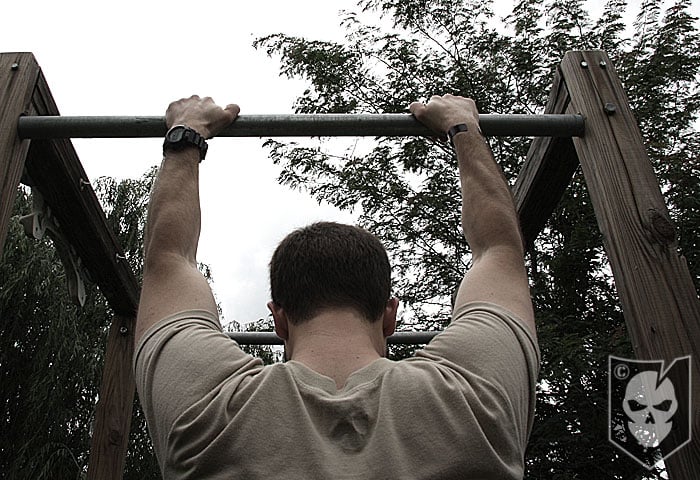
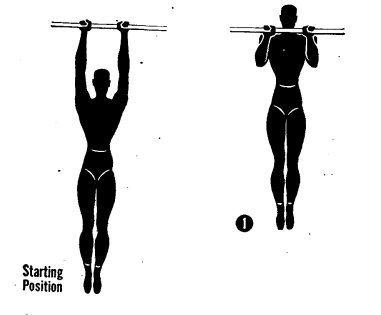 This event requires a horizontal bar. This may be made of a pipe or gymnasium horizontal bar, or other rigid horizontal support which is not over 1 ½ inches in diameter. The bar should be high enough to permit the performer to hang at full length without touching the ground. A height of 7 feet, 9 inches to 8 feet is recommended.
Starting Position. Hanging at full length from the bar with arms straight. The forward grasp is used with the palms turned away from the face.
Movement. Pull up until the chin is above the level of the bar. Then lower the body until elbows are completely straight. Continue for as many repetitions as possible.
Instructions. The men should be told that it is permissible to raise the legs and flex the hips when pulling up but not to kick or execute a jerking motion with trunk or legs. The body must be kept from swinging. The chin must be raised above the bar. The arms must be completely straight at the bottom of the movement.
Administration and Scoring. Each time the performer pulls his chin above the bar in correct form, he is given credit for one pullup. He is not credited with a pullup if he fails to raise his chin above the level of the bar or if he stops to rest. If the performer does not straighten his arms at the bottom of a movement, if he kicks or jerks, only half a pullup will be counted. If there are four half-pullups, the performer should be stopped and retested later. If the performer starts to swing, the judge should stop the swinging with his hands. Some such aid as a resin-bag or a cake of magnesium carbonate should be available to prevent the hands from slipping.
TEST 2: SQUAT JUMPS
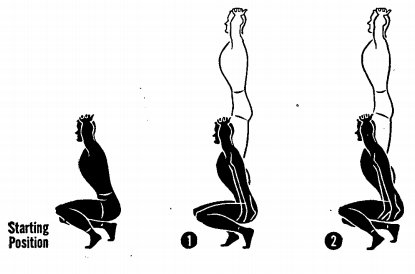 Starting Position. Squatting on right heel with fingers laced on top of head, palms down. The feet are 4 to 6 inches apart with the heel of the left foot on a line with the toes of the right foot.
Movement. Spring upward until both knees are straight and both feet clear the ground. Jump just enough to permit straightening the knees without touching the ground. Do not jump any higher than necessary to accomplish this purpose. Keep the upper body erect. While off the ground, reverse the position of the feet bringing the right foot in front. Then drop to a squat on the left heel. Keep the knees pointing forward. Spring up again and continue for as many repetitions as possible.
Instructions. The men should be told that the most common errors are: getting the feet too far apart, forward and backward and failing to squat down on the rear heel. The correct position should be demonstrated clearly and the men should be given sufficient practice to master it. The action must be continuous throughout. Before beginning the event, the men should be told that it requires courage almost to the same extent as it requires strength and endurance and that they should not give up until they cannot make another movement.
Administration and Scoring. The performer is credited with one squat jump each time he springs up from the squat to the erect position and returns. The movement is not scored if he fails to descend to a complete squat, if he does not straighten his legs completely and reverse his feet while he is in the air, if he removes his hand from his head, or if he discontinues the movement and comes to a stop. If he loses his balance and removes a hand from his head momentarily, or falls but immediately recovers and continues, he shall not be penalized. If the performer gets his feet too far apart but comes to a squat on the rear foot, there is no penalty. Some men cannot squat all the way down on the heel. If they go down as far as possible they should not be penalized.
TEST 3: PUSHUPS
Starting Position. The performer assumes the front leaning rest position with the body straight from head to heels. His palms are directly underneath the shoulders and elbows are straight. Fingers pointed forward. The judge sits on the ground beside the performer, with one palm down on the ground underneath the lowest part of the performer’s chest.
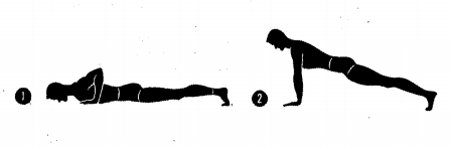
Movement. Lower body until chest touches the ground (in informal practice), or touches the hand of the judge (in formal testing). Elbows must point directly to the rear. Return to the original position by straightening elbows. Keep the entire body in a straight line throughout. Repeat as many times as possible.
Instructions. The performer is told: that the arms must be straight at the start and completion of the movement; that the chest must touch the judge’s hand; and that the stomach, thighs, or legs must not touch the floor. Hands and feet must not move from their positions. He is also told that the whole body must be kept straight as he pushes the shoulders upward; that is, the shoulders should not be raised first and then the hips or vice versa. The judge uses his free hand to guide the man in case he is raising his hips too much or raising his shoulders first. In the first instance, he taps the man on the top of the hips to straighten them out; in the second case he taps underneath the abdomen to make him raise his abdomen with the same speed as his shoulders.
Administration and Scoring. The performer is credited with one pushup each time his arms are completely straightened and the exercise is performed in acceptable form. There is no penalty for the hips being slightly out of line if the whole body is moving upward at about the same speed. The men may proceed but may not stop to rest. If a man violates any of the instructions given above, he is credited with a half-pushup. If and when the performer is no longer able to hold a correct front leaning rest, the test is terminated.
TEST 4: SITUPS
Starting Position. Performer lies on his back with knees straight, feet approximately 18 inches apart and fingers laced behind head and elbows on the ground. The scorer kneels on the ground at the performer’s feet and presses the performer’s ankles firmly down against the ground.
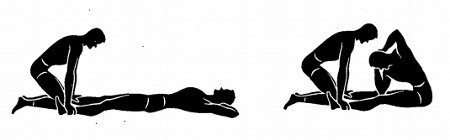
Movement. Raise upper body rotating it somewhat to the left and then forward far enough to touch the right elbow to the left knee. The knees may bend slightly when sitting up. Lower the body until the back and elbows again touches the ground. Again sit up, but this time rotate the trunk to the right and touch left elbow to the right knee. Again lower the body until the back touches the ground. Perform as many situps as possible in two minutes. Rest pauses are permitted during the test but count toward the 2-minute period.
Instructions. The performer should be warned that he must keep his knees straight until he starts to sit up; that he must touch his knee with the opposite elbow; and that he may not push up from the ground with his elbow.
Administration and Scoring. Performer is given credit for each situp completed within the 2-minute period. No score is given if he unclasps his hand from his head, if he pushes up from his elbow, or if he keeps his knees bent while lying back on the ground. He is not penalized if the elbow misses the knee slightly. He must, however, sit up far enough so that the elbow almost touches the knee. Time should be announced every 20 seconds. At the end of 2 minutes, the timer calls: STOP and the judge counts the full number of situps completed before the stop command.
TEST 5: 300-YARD RUN
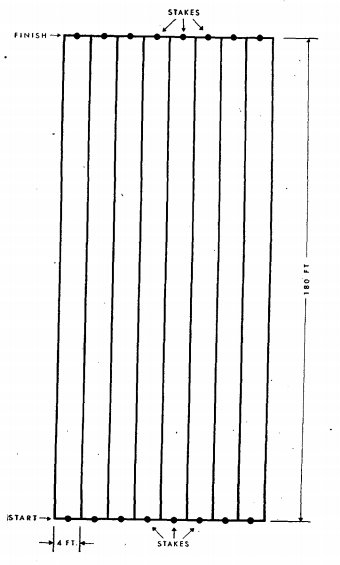 A course 60 yards long is laid out on flat level ground with lanes 4 feet wide for for each runner. Both ends of the course have cross-marks at right angles to the lanes. The cross-mark at one end serves as a starting line; the one at the other end, as a finish line. In the middle of the cross mark at either end of each lane is a stake which is at least 1 ½ feet high. If possible the lanes should be marked out in lime. If there are no lanes, it is recommended that the stakes be numbered or painted different colors. Each performer must run around his stake without grasping it.
Starting Position. Standing behind the starting mark in the lane with rear foot braced by another man’s foot placed crossways behind it.
Movement. At the starting signal, run to the stake at the farther end of the lane. Run around the stake at the finish line. Then return and run around the stake at the starting line. Continue until five lengths of the course, or 300 yards have been run. Make each turn from right to left. The run will finish at the opposite end of the course from which it started.
Instructions. The men should be told to run about 9/10ths full speed, to run straight down the lane, to turn around the far stake from right to left without touching it and to return running around the stakes one after another until they have traveled five full lengths. The men should also be instructed to walk around slowly for 3 or 4 minutes after completing the run. Recovery will be much more rapid if they walk than if they lie down.
Administration and Scoring. Each runner has one inspector, or judge, who stands at the finish line. The judge watches his runner to see that he makes the turns properly and observes all the rules. This inspector also holds the man’s card and records his performance. A timekeeper stands on one of the lines in the middle of the course, 20 feet away from the finish line. The men are started by the starter with ordinary signals of: “Get on your mark; get set; go.” Since the timer starts his watch by the “go”, the starter should also use a hand signal. When the first runner is about 30 yards away from the finish line, the timer begins to count the seconds aloud using “hup” for the half-seconds. For example, he counts “44, hup, 45, hup, 46, hup, 47, hup, 48, hip, etc.” The judge for each man listens to the count and at the same time watches his runner. He then records the last full second or half-second, which was counted before the man reached the finish line. After the inspector records the time on the man’s scorecard he returns the card to him.
TEST 5A: INDOOR SHUTTLE RUN
A course 25 yards long is laid out on the gymnasium floor with a lane 4 feet wide for each runner. The lanes should be marked on the floor with water-solvent coloring, chalk, paint or adhesive tape. Turning boards are placed at both ends of the course. Each turning board is placed at a 45 º angle, facing inside the lane and toward the runner. The turning boards must be firmly braced and made of heavy material. They should be from 12 to 16 inches in width. The lower edges of the turning boards are flush with the end of the lines of the running area. The number of each lane will be painted on the face of its board.
Starting Position. Ready for a sprint start, with one foot braced against a turning board and the other foot and the hands extended into the lane.
Movement. On the starting signal, run to the turning board at the other end of the lane. Touch board with foot or feet. Turn and continue running until completing ten shuttle trips or laps (for a total of 250 yards). Touch the turning board at the end of each lap, except the final one. At the end of the final lap, the runner will continue across the turning board. Any footwork may be used in making the turn provided the foot or feet touch the turning board each time.
Instructions. Each runner must stay in his own lane. Any method may be used in making the turn, although it is recommended that the forward foot touch the block on the turn. In the event a runner falls or is hindered by another participant entering his lane during the progress of the run, he may be permitted to repeat the run later in the same period.
Administration and Scoring. This event is administered and scored as the 300-yard run. The time of the run is taken as the runner’s body passes beyond the turning board on the final lap.
TEST 5A(l): 60 SECOND SQUAT THRUST
When it is not possible to employ the indoor shuttle run as a substitute for the 300-yard run the 60-second squat thrust should be used.
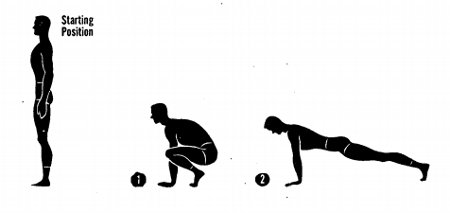
Starting Position. Attention.
Movement. Bend at knees and hips and, squatting down, place hands on ground shoulder width apart. Keep the elbows inside the knees. Thrust feet and legs backward to a front leaning rest position. Keep body straight from head to heels. Support weight on hands and toes. Recover to the squatting position. Then recover to starting position.
Instructions. The men should be told that in executing this movement for speed the shoulders should be well ahead of the hands when the legs are thrust backwards. Extending the legs too far backward, so that the shoulders are behind the hands, makes it difficult to return to the original position with speed. On the preliminary practice, the performer is told he will score better if he does not make a full knee-bend, but bends his knees only to about a right angle; and that he should keep his arms straight. It is not a failure if he bends his arms but the performer will not be able to score as well.
Administration and Scoring. A score is given for the successful performance of each complete squat thrust. No score is given if: the feet start backward before the hands are placed on the ground; the hips are raised above the shoulder-heel line when the feet are back; or the performer does not fully recover to the erect position on the fourth count. The judge should not count aloud as this is apt to confuse other nearby judges. If the man is performing the event incorrectly, the judge should coach him, or stop him and have him repeat the test after more coaching.
How Did You Do? Check the Score Sheet.
Editor-in-Chief’s Note: The Art of Manliness is a fantastic Website dedicated to uncovering the lost art of being a man. It features articles on helping men be better husbands, better fathers and better men.



Discussion