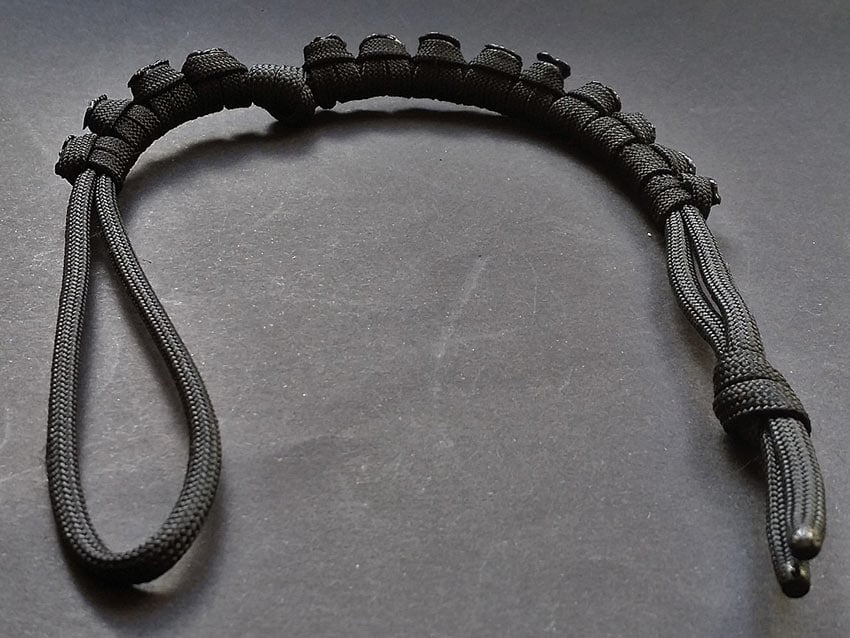
Many outdoor gear brands sell thin webbing belts. These belts aren’t meant to hold much gear, they simply hold your pants up. The thin, pliable webbing makes for a svelte belt that can be comfortably worn under a pack hip belt or a climbing harness. The webbing also tends to be of a low quality and the belts are often priced ridiculously high. Why pay $15 for something that you can make yourself at little cost, if not for free?
I had worn a Frequent Flyer Belt from The Wilderness Tactical on a daily basis for a number of years. It is an excellent belt, but I occasionally found the wide and thick webbing, which is appropriate for some uses, to be uncomfortable and cause chafing under the heavy hip belt of my pack. As an experiment, I purchased a Patagonia Friction Belt when it was heavily discounted during a sale. That worked well for a while — it was more comfortable under my pack — but the webbing used was very low quality. It was also still a bit stiff. I thought, why should there be any stiffness at all to the belt? It serves no purpose in the backcountry. [Read More…]
Here is a very simple, stealthing project for your Casio G-Shock watches. I am planning to do a lot more to my little DW-5600 like reverse the display, stealth the faceplate (if possible), but for now I wanted to stealth the bezel (aka: remove the white paint).
The first step is to gather all the necessary equipment. For this project you’ll need some Goof Off (not Goo Gone or any similar sounding products), a small ceramic bowl/dish (plastic ones may melt with the Goof Off inside it) this is one I made myself, a small pair of tweezers, and an old toothbrush or scrubbing brush. [Read More…]
Duct tape is one of the most useful things on the planet. It can be used to secure, repair, or build in ways that other materials such as rope, glue, or conventional tape cannot.
Because of the hundreds of applications for this miracle material, I have always loved duct tape. I’m especially fond of Gorilla brand duct tape, which has 50% more glue than conventional silver duct tape and adheres to damn near anything.
Unfortunately, while convenient to use, duct tape is very inconvenient to carry around. It comes in these large, 20-yard rolls with a big hole in the center, which makes the tape take up far more space than it should. When you’re carrying a full bag, that extra space could be crucial.
I have found three different ways to easily carry around duct tape: in a mini-roll, a collapsed roll, or on a keychain. [Read More…]
There’s enough information out there about sharpening knives to fill an encyclopedia and in fact many books have been written on the topic.
Many of us that sit down to sharpen our cutting tools end up with a dull edge, or only occasionally achieve a nice sharp edge. While some of us can get a sharp edge consistently, we find that it doesn’t last long.
I was such an individual at one time and this article is aimed at laying a foundation for getting a consistent edge that will last. [Read More…]
This project was quite adventurous for me and quite a bit more complicated than some of the other projects I’ve done with my G-Shock watches.
It involves doing some pretty nasty things to the screen of a “naked” G-Shock, so if you’re faint-hearted this is probably not the ideal DIY project for you.
If you’re still reading this and desperately wanting to try reversing the display of one of your digital watches for yourself – read on! [Read More…]
I’ve been planning to make a Morale Patch Display Frame for a long time now, as I’ve slowly been running out of room in my MSM MegaPatch Book. Finally having a HQ and an overall lack of things on the wall, prompted me to finally make one.
My requirements were simple, I wanted a place to not only display Velcro-backed Morale Patches, but also display the patches people send us that don’t have hook on the back. To do this I knew I needed some type of cork board backing behind the Velcro.
Today I’ll be taking you through the process I used to create a DIY Morale Patch Display Frame, I hope that you’ll be able to use these instructions to create your own too! [Read More…]
Today I’m going to share some techniques with you that I came up with for creating dead drop devices during a previous SCG International Tactical HUMINT Operations course.
One of our taskers at the end of one class day was to create two dead drops by the next morning. This assignment was give to us at around 6 p.m., so with limited time, I did what anyone wanting to create dead drop devices would do. I hit the local Wal-Mart. [Read More…]
In this article we are going to show you how to make a low-cost low-profile entry tool that you can pick up at your local Lowe’s or Home Depot.
I came across this idea over at Lightfighter.net when I was looking at a thread called Active Shooter Loadouts. Around that time I had taken a class by John Giduck on active shooters and the Beslan School siege, Amish massacre, and the Virginia Tech shooting. It was quite eye opening and John brought up some good points on the need to be able to breach your way into one of these events. [Read More…]
This is a short how to article for anyone interested in working with KYDEX. I’m sure most of the people here know of KYDEX and many of you probably own a KYDEX sheath or holster that was either sold with a blade or purchased for a hand gun.
My personal experience working with KYDEX is somewhat limited and there may be others here with more experience and knowledge on the subject, so feel free to add your thoughts. [Read More…]
Whether you consider yourself a novice or pro when it comes to lock picking, there’s no denying that everyone needs to keep up their skill-set without damaging their house locks.
Today we’re going to show you how to build an inexpensive lock pick practice set for less than $40 that will rival the stands, kits and sets that cost three times that.
With just a quick trip to Home Depot, you’ll be on your way to creating your own set to work with and ensure that the next time you’re locked out of your house, you’ll be able to get back in! [Read More…]
Recent Comments